India’s Creative Twist on Google’s Nano Banana Leads the Way
▼ Summary
– Google’s Nano Banana model has driven significant global adoption of the Gemini app, with India emerging as the top country for usage.
– Indian users are engaging with the model in uniquely creative ways, including generating retro Bollywood-inspired portraits and AI saree images.
– The app has topped download charts in India and globally, with Indian downloads surging by 667% after the Nano Banana update.
– Despite leading in downloads, India accounts for only 1.5% of in-app purchases, though it shows strong month-over-month spending growth.
– Google is addressing privacy concerns by using watermarks and SynthID to identify AI-generated content, while testing a detection platform for wider use.
India has quickly become the epicenter of creative engagement with Google’s Nano Banana, the popular image-generation feature within the Gemini app. Since its debut last month, the tool has seen explosive adoption in the country, where users are blending artificial intelligence with rich cultural expression in ways that have captured global attention.
According to David Sharon, who leads multimodal generation for Gemini Apps at Google DeepMind, India now leads the world in usage of the Nano Banana model. This surge has also driven the Gemini app to the top of both the App Store and Google Play rankings within the country. Given India’s massive smartphone user base and digital population, widespread adoption comes as little surprise. What stands out, however, is the distinctly local and imaginative ways people are putting the AI to work.
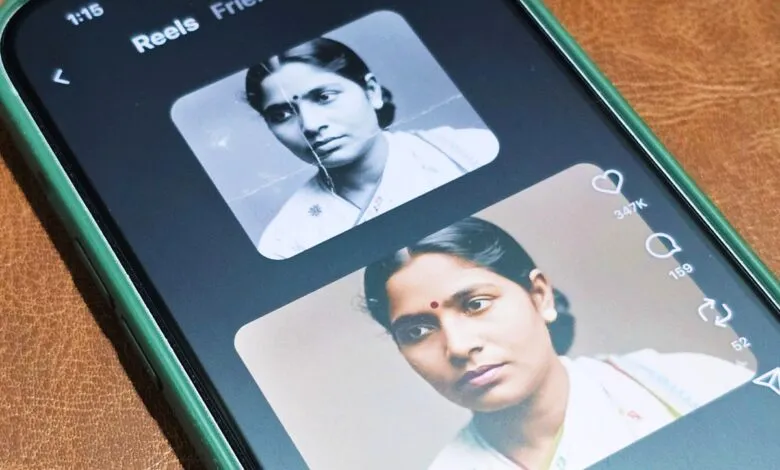
One of the most prominent trends involves users recreating retro portraits inspired by 1990s Bollywood aesthetics. People are generating images of themselves as they might have looked decades ago, complete with period hairstyles, makeup, and fashion. A related movement, dubbed the “AI saree” trend, focuses on vintage-style portraits featuring traditional Indian attire.
Another popular use case involves placing AI-generated selfies against the backdrop of global landmarks like Big Ben or classic British telephone booths, a trend Sharon noted was especially common in the early days of the feature’s release.
Indian users are also experimenting with more whimsical applications, such as transforming everyday objects, creating time-travel themed visuals, or reimagining themselves as retro postage stamps. Some are producing black-and-white portraits or visualizing encounters with their younger selves.
While not all these trends originated in India, the country has played a pivotal role in amplifying their reach. The “figurine” trend, for example, where users create miniature versions of themselves, first emerged in Thailand, spread to Indonesia, and went global after gaining momentum among Indian users.
Beyond still images, Google has observed Indians using the Veo 3 video-generation model within Gemini to animate old family photographs, bringing grandparents and great-grandparents to life in short video clips.
This wave of creativity has significantly boosted the Gemini app’s popularity. Data from Appfigures shows that between January and August, India accounted for an average of 1.9 million monthly downloads, roughly 55% more than the U.S., making up 16.6% of global installs. Year-to-date, India has seen 15.2 million downloads compared to 9.8 million in the U.S.
The release of the Nano Banana feature triggered a dramatic spike in daily downloads starting September 1, with installations peaking at 414,000 on September 13, a 667% increase. Since then, Gemini has consistently held the number one spot in both app stores across all categories.
Despite leading in downloads, India does not top in-app purchase revenue. Global consumer spending on iOS has reached an estimated $6.4 million since launch, with the U.S. contributing $2.3 million (35%) and India accounting for $95,000 (1.5%). However, India’s spending growth is accelerating rapidly, with an 18% month-over-month increase in September, outpacing both the global average and U.S. growth.
As with many AI tools, privacy and data security remain important considerations. Users worldwide are uploading personal photos to generate transformed images, raising questions about how this data is handled. Sharon emphasized that Google aims to fulfill user requests without assuming intent, and the company continues to refine its approach to safety and transparency.
To help identify AI-generated content, Google marks images created with Nano Banana using a visible diamond-shaped watermark and an invisible SynthID fingerprint. The company is also testing a detection platform with trusted partners and plans to release a public tool that allows anyone to verify whether an image was AI-generated.
Sharon acknowledged that this is still early days for the technology, noting that feedback from users, press, and experts will be essential in shaping its future development.
(Source: TechCrunch)