Why Automation Still Needs Humans: The Unlikely Trio of Bananas, Champagne & Robots
▼ Summary
– The first Robot Humanoid Games in China highlighted both the progress and current limitations of robotics, as humanoid robots struggled with basic physical tasks like walking and soccer.
– Picnic Technologies uses automation in its warehouses to compile grocery orders efficiently, with robotic arms handling item picking to support human delivery workers.
– Despite automation, humans remain essential at Picnic for handling irregularly shaped items, fragile goods, high-value products, and final packing due to robots’ limitations in adaptability and dexterity.
– Picnic’s CTO emphasizes that automation aims to enhance human work rather than replace it, fostering a collaborative model where robots boost efficiency while humans handle complex tasks.
– The company promotes “AI-free days” to sharpen human skills and believes AI will transform management by increasing autonomy and reinventing roles rather than eliminating them.
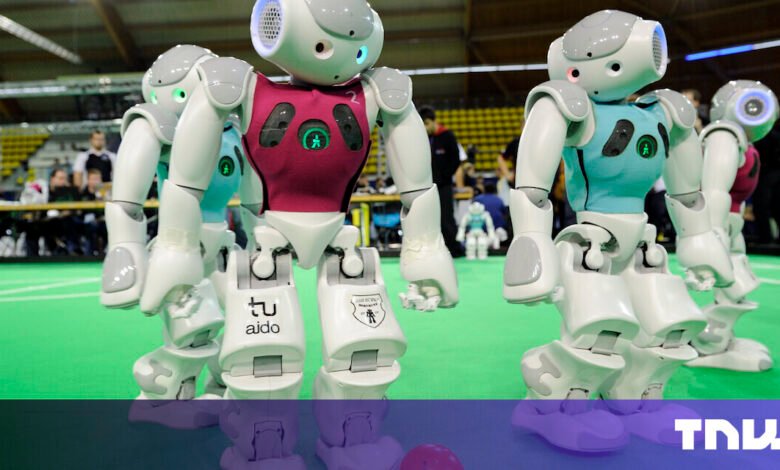
The recent spectacle of humanoid robots stumbling through athletic events at China’s inaugural Robot Humanoid Games offered both amusement and a dose of reality. It showcased remarkable progress in robotics while underscoring how much further the technology must evolve. While humanoid robots still struggle to walk across a stage, automation is already reshaping industries in less visible but more practical ways.
At Picnic Technologies, the Netherlands’ rapidly expanding online supermarket, automated systems efficiently compile grocery orders. This allows delivery personnel to transport items from warehouse to doorstep with impressive speed. Such innovations have enabled the startup to compete effectively with retail giants like Albert Heijn.
Daniel Gebler, the company’s Chief Technology Officer, recently discussed the strategic thinking behind this success during a conversation recorded while traveling through Amsterdam. Though Gebler holds a doctorate in artificial intelligence and champions automation, he emphasizes that robots won’t replace humans entirely.
Previously, Picnic’s shopping staff manually navigated vast warehouses to gather products for delivery. Today, automated fulfillment centers in the Netherlands and Germany use robotic arms to select items, significantly reducing physical strain and increasing efficiency. The facility in Oberhausen, Germany, can process up to 33,000 orders daily, serving 200,000 households. It operates with 1,500 robots, and 1,000 human employees.
The persistent need for human workers stems from specific limitations in current automation. Robots struggle with irregularly shaped items, fragile goods like eggs, or high-value products like champagne bottles. Humans excel at spatial reasoning, easily rearranging crates to optimize space, whereas robots depend on fixed layouts. Simple actions like opening boxes also present challenges for machines. Even in highly automated environments, the final step of packing orders into delivery crates remains a manual task.
To accommodate these constraints, Picnic uses product whitelisting to determine which orders robots can handle. An order containing both bags of crisps and heavy soda bottles, for example, would be assigned to a human worker. This practical approach reflects the company’s philosophy toward automation.
Jhon Mauro Gomez, a software engineer at Picnic, clarifies their stance: “Absolutely not. As mentioned, it isn’t our goal to replace them either, but rather to use robots to boost our warehouse’s performance. Shoppers remain at the core of our warehouse operations, with robots complementing their efforts.” The relationship is one of collaboration, not replacement.
Artificial intelligence is also transforming organizational management, though not necessarily by eliminating leadership roles. Gebler suggests that traditional management structures may evolve into something new, with increased emphasis on ownership and cross-functional involvement. “The relevance of ownership, owning what you build, owning what you run, will become even more important. Because everybody will be a designer, a builder, and also an operator.”
This shift toward greater autonomy has already inspired innovation at Picnic. Development teams have introduced return deliveries for third-party retail items, improving fleet utilization. They’ve also designed curated meal packages, offering more value to families than individual products alone.
Gebler also advocates for “AI-free days,” dedicated periods where developers set aside automated tools to hone their innate problem-solving abilities. While AI excels at processing data, it lacks human improvisation and creative intuition.
Whether in grocery logistics or corporate strategy, the most effective future lies in synergy between human and machine. Automation handles repetitive, structured tasks with precision, while people contribute adaptability, judgment, and ingenuity. From managing delicate produce to preserving human skills, Picnic demonstrates that technological progress isn’t about displacement, it’s about enhancement.
(Source: The Next Web)