David Sacks Steps Down as White House AI and Crypto Czar
▼ Summary
– David Sacks has left his role as President Trump’s Special Advisor on AI and Crypto after his special government employee status expired.
– He will now co-chair the President’s Council of Advisors on Science and Technology (PCAST), where he can advise on a broader range of tech topics.
– His previous role gave him significant influence on AI policy, but his aggressive tactics led to political backlash and alienated key Republican groups.
– Sacks recently drew criticism from Trump’s supporters by publicly suggesting the president needed an “off-ramp” from the conflict with Iran.
– The White House has a pattern of reassigning controversial figures, as seen with other officials like Mike Waltz and Kristi Noem.
David Sacks, the prominent venture capitalist who served as the White House’s chief advisor on artificial intelligence and cryptocurrency, has officially left that role. He confirmed on Thursday that his status as a special government employee has concluded, ending his tenure as President Donald Trump’s Special Advisor on AI and Crypto. This position, which granted him significant influence over the administration’s aggressive tech policy, was limited to 130 days of service, a period Sacks stated he has now fully utilized. He will now shift his focus to co-chairing the President’s Council of Advisors on Science and Technology (PCAST), a role he says will allow him to offer recommendations on a broader range of technological issues.
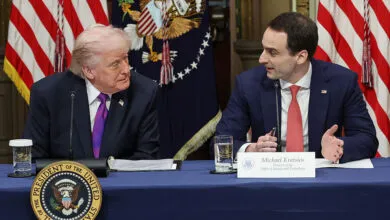
The move comes shortly after the White House announced several new appointments to PCAST, adding tech industry leaders like Mark Zuckerberg, Marc Andreessen, Jensen Huang, and Sergey Brin. Michael Kratsios, head of the Office of Science and Technology Policy, will also serve as a co-chair. In an interview with Bloomberg Television, Sacks clarified the nature of his new advisory capacity, noting it is intended to provide direct counsel to the president and the executive offices rather than coordinate with federal agencies.
As the administration’s AI and crypto czar, Sacks held considerable sway, with direct access to the Oval Office stemming in part from his role hosting a major Silicon Valley fundraiser for Trump in 2024. However, his assertive policy approach generated significant political friction. His push for a sweeping federal preemption of state AI laws, pursued through both legislation and executive action, alienated key Republican governors and factions within the MAGA movement. Critics argue this strategy turned potential policy victories into political liabilities. “He failed to get preemption. He pressed the White House into a culture war against its own voters,” said Michael Toscano of the conservative Institute for Family Studies, who described Sacks’ impact as a “political disaster.”
The situation was further complicated last week when Sacks publicly critiqued the president on his podcast, suggesting Trump needed an “off-ramp” from the conflict with Iran. Such public criticism is often viewed dimly within Trump’s political orbit. The shift to a PCAST role follows a pattern in Trump’s second term where controversial figures are often reassigned rather than dismissed outright, as seen with previous officials like Mike Waltz and Kristi Noem. For Sacks, the transition marks an end to a powerful but polarizing chapter at the center of Washington’s technology policy battles.
(Source: The Verge)