The First Truly Self-Driving Cars Have Arrived
▼ Summary
– The development of autonomous vehicles is a gradual process that began much earlier than commonly thought, tracing back to the early 20th century.
– Spanish engineer Leonardo Torres Quevedo pioneered early remote-control systems, most notably inventing the wireless Telekino system.
– The Telekino used wireless signals to control machinery from a distance, originally conceived to prevent airship accidents by transmitting commands.
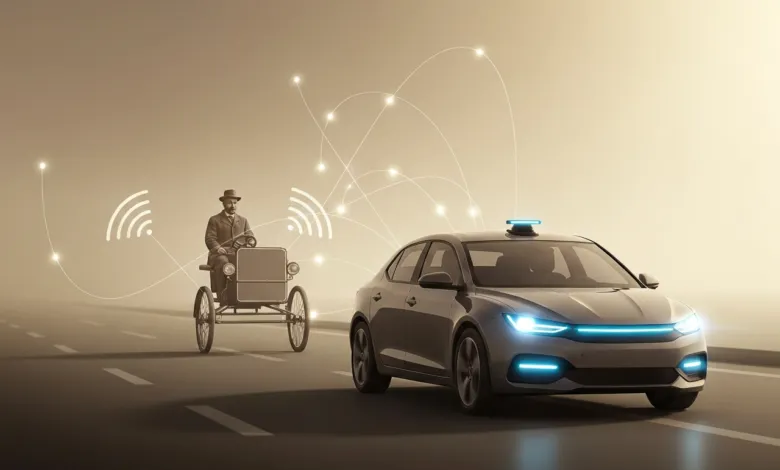
– In 1904, Quevedo demonstrated this technology by remotely controlling a small vehicle, marking the earliest recorded instance of radio-controlled vehicle guidance.
– Despite successful demonstrations on various platforms, the technology’s development stalled due to a lack of funding and support from the Spanish Crown.
The journey toward fully autonomous vehicles is a fascinating story of incremental progress, not a sudden technological revolution. While the modern era of self-driving cars captures headlines, the foundational concepts stretch back over a century to a brilliant and largely forgotten Spanish inventor. The quest to remove human hands from the controls began far earlier than most people realize, with pioneering work that laid the groundwork for today’s advanced robotics and artificial intelligence systems.
In the early 1900s, a Spanish engineer named Leonardo Torres Quevedo was already experimenting with machines that could operate without direct human guidance. Born in 1852, Quevedo was a prolific inventor whose creations demonstrated a remarkable vision for automation. His most famous invention, developed in 1914, was a mechanical chess-playing automaton that could challenge a human opponent. However, his most significant contribution to the lineage of self-driving technology came more than a decade earlier with his work on remote control systems.
Quevedo’s groundbreaking invention was the Telekino, a name derived from Greek words meaning “movement at a distance.” He secured patents in Spain, France, and the United States for this system, which he originally designed as a safety mechanism for airships. The core idea was to allow an operator to control a vehicle’s functions without any physical tether. The Telekino worked by transmitting wireless signals to a receiver, which used a device called a coherer to detect electromagnetic waves and convert them into an electrical current. This current was then amplified to power electromagnets, which would rotate a switch to activate the appropriate servomotor. This clever arrangement enabled an operator to send up to 19 different commands to steer and manage an airship remotely.
By 1904, Quevedo had successfully adapted his Telekino to pilot a small, three-wheeled vehicle from a distance of about 100 feet. This demonstration is recognized as the first documented instance of a radio-controlled vehicle. He further proved the system’s versatility by testing it on boats and even torpedoes, showcasing its potential for both civilian and military applications. Despite these promising proofs of concept, the technology’s development stalled. The Spanish government, hesitant and conservative with its investments, chose not to provide the necessary financial backing. Without this crucial support, Quevedo was unable to manufacture or commercialize the Telekino, and his visionary work faded into relative obscurity for decades.
(Source: Ars Technica)