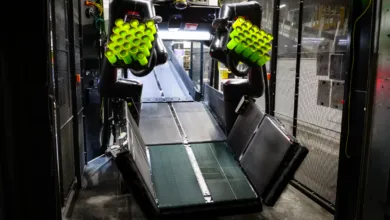
Amazon scraps Blue Jay robotics project in under six months

▼ Summary
– Amazon has halted its Blue Jay warehouse robotics project, a multi-armed robot for sorting packages, just months after unveiling it.
– The company stated Blue Jay was a prototype and will use its core technology for other robotics manipulation programs.
– Amazon credited the rapid development of Blue Jay, which took about a year, to advancements in artificial intelligence.
– The company also unveiled the Vulcan robot last year, a two-armed system designed to handle and “feel” items in warehouse storage.
– Amazon’s internal robotics program, which began with the 2012 purchase of Kiva Systems, now includes over a million robots in its warehouses.
While Amazon operates a vast fleet of hundreds of thousands of robots across its fulfillment network, not every automation project reaches full-scale deployment. The company has recently discontinued its Blue Jay warehouse robotics project less than six months after its public introduction. This multi-armed robot, designed for sorting and moving packages within same-day delivery facilities, was initially revealed in October. At that time, Amazon highlighted its rapid development cycle of roughly one year, a pace made possible by advancements in artificial intelligence.
A company spokesperson clarified that Blue Jay was always intended as a prototype, a detail not emphasized in the original announcement. The core technology developed for the project will not go to waste. Amazon plans to apply it to other robotics manipulation initiatives, and the team behind Blue Jay is being reassigned to different programs. This strategic pivot underscores a focus on iterative innovation, where lessons from one project fuel progress in others.
The decision to halt Blue Jay follows the earlier introduction of another robotic system named Vulcan. This two-armed machine operates within storage compartments, using one arm to rearrange items and another, equipped with a camera and suction cups, to handle goods. Vulcan’s design incorporates tactile feedback, allowing it to sense objects, and its training utilized data from countless real-world interactions.
Amazon’s substantial investment in robotics traces back to its 2012 acquisition of Kiva Systems. That purchase provided the foundational automation technology that now drives its global logistics. The company’s robotic workforce has grown exponentially, surpassing one million units in its warehouses last summer. This ongoing evolution demonstrates a commitment to refining automation through experimentation, where some concepts, like Blue Jay, serve as valuable stepping stones rather than final products.
(Source: TechCrunch)