Positron Secures $230M to Challenge Nvidia in AI Chip Race
▼ Summary
– Semiconductor startup Positron has raised $230 million in Series B funding to accelerate deployment of its high-speed memory chips for AI workloads.
– Key investor Qatar Investment Authority (QIA) is part of a broader Qatari strategy to build sovereign AI infrastructure and become a leading AI hub in the Middle East.
– The funding round reflects a push by hyperscalers and AI firms, like OpenAI, to reduce their reliance on Nvidia’s AI chips.
– Positron’s first-generation chip, Atlas, claims to match Nvidia H100 GPU performance for inference tasks while using less than a third of the power.
– The startup, now with over $300 million in total funding, focuses on AI inference hardware for running models, capitalizing on the shift from model training to deployment.
A semiconductor startup based in Reno has successfully raised $230 million in a Series B funding round, a significant financial injection aimed at accelerating its challenge to industry giant Nvidia. The capital will be used to fast-track the deployment of its specialized high-speed memory chips, which are essential components for the hardware running today’s demanding artificial intelligence applications. This development arrives as major technology companies and AI labs actively seek to diversify their supply chains and reduce dependence on a single dominant provider.
The investment round attracted participation from the Qatar Investment Authority (QIA), the nation’s sovereign wealth fund, which is deepening its strategic focus on artificial intelligence infrastructure. This move aligns with Qatar’s broader ambition to establish itself as a leading hub for AI services in the Middle East, viewing substantial compute capacity as a non-negotiable requirement for global economic competitiveness. The country’s commitment was a central theme at the recent Web Summit Qatar in Doha and is further evidenced by a separate, massive $20 billion AI infrastructure joint venture announced with Brookfield Asset Management last September.
For the three-year-old company, Positron, this latest fundraise brings its total capital secured to just over $300 million. The startup had previously gathered $75 million in a prior round from investors such as Valor Equity Partners and Atreides Management. The company is carving out its niche by concentrating on the inference segment of the AI workflow, the computing process required to run already-trained AI models in real-world applications, rather than on the initial model training phase. This strategic focus positions the firm to capitalize on the surging market demand for efficient inference hardware, as businesses increasingly pivot from building large language models to deploying them practically at scale.
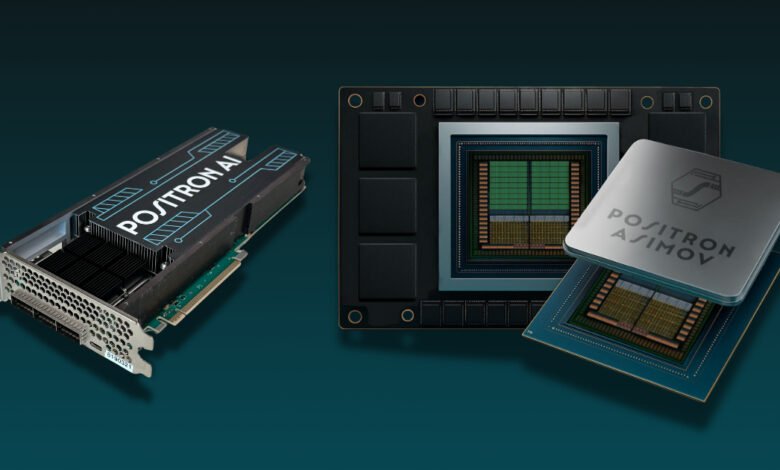
Positron’s flagship product, the first-generation Atlas chip manufactured in Arizona, is central to its competitive pitch. The company asserts that the Atlas can deliver performance comparable to Nvidia’s flagship H100 GPUs while consuming less than a third of the power. This claim of superior power efficiency, if borne out in widespread deployment, could present a compelling alternative for cost- and energy-conscious enterprises. Beyond its core memory technology, sources indicate Positron’s architecture also demonstrates strong capabilities in handling high-frequency and video-processing workloads, broadening its potential use cases.
The funding news underscores a growing trend within the AI industry, where key players like OpenAI, despite being one of Nvidia’s most significant customers, are reportedly exploring alternative chip suppliers due to performance or supply concerns. This environment of seeking viable alternatives is creating fertile ground for well-funded challengers like Positron to gain traction and market share in the critical race for next-generation AI hardware.
(Source: TechCrunch)