Mercedes Pauses Its ‘Eyes-Off’ Self-Driving Tech
▼ Summary
– Mercedes-Benz is pausing the rollout of its Level 3 “Drive Pilot” system for the revised S-Class, citing low customer demand and high production costs.
– Drive Pilot allowed hands-free, eyes-off driving at up to 40mph in traffic jams, representing a significant leap from driver-assist Level 2 systems like Tesla’s.
– The system’s appeal was limited by a restrictive operational domain, being legal only in Germany and parts of California and Nevada, and requiring specific conditions like clear weather.
– Mercedes is shifting focus to a new Level 2++ system called Drive Pilot Assist, which offers broader use but requires the driver to remain attentive, similar to Tesla’s FSD.
– The practicality of Level 3 automation is debated due to safety concerns about the handoff to human drivers, with some autonomous companies preferring to skip to Level 4 technology.
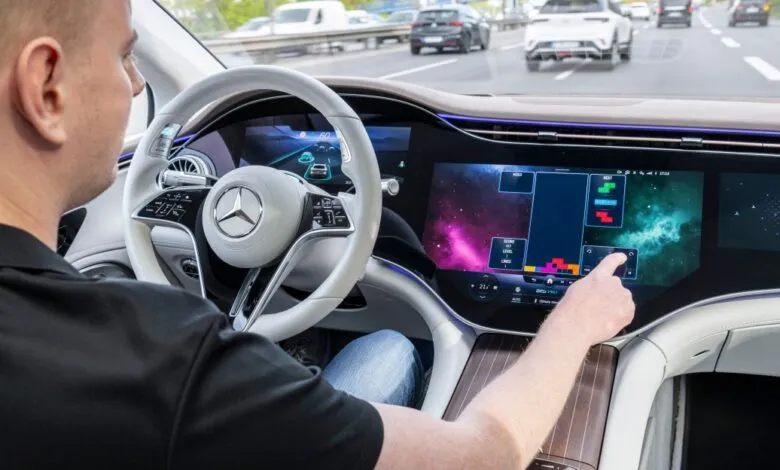
Mercedes-Benz has temporarily halted the deployment of its Drive Pilot system, a significant “eyes-off” automated driving technology previously available in select markets. The automaker confirmed that the upcoming revised S-Class model, arriving soon, will not include this Level 3 capability. This decision marks a notable shift for a company that pioneered consumer access to such advanced automation, initially launching Drive Pilot on models like the EQS sedan and S-Class. The system represented a major advancement over common Level 2 features, such as Tesla’s Autopilot, by legally permitting drivers to divert their attention from the road under specific conditions, like highway traffic jams at speeds up to 40 mph.
The pause is attributed to a combination of factors, including limited customer demand and the substantial production costs associated with the sophisticated technology. A company spokesperson explained that the system’s appeal was constrained by its narrow operational scope. Drive Pilot’s use was legally restricted to Germany and certain highways in California and Nevada. Its functionality also depended on a strict set of circumstances: a lead vehicle must be present, road markings needed to be clear, and conditions had to be dry and daylight. It could not operate at night, in rain, or on unmapped highways, significantly limiting practical utility.
Alongside these challenges, Mercedes encountered supply chain issues. The development relied on lidar sensor technology, but a partnership with supplier Luminar was terminated after performance requirements were not met. This sensor redundancy was considered crucial for overcoming camera limitations, such as sun glare. The high costs of integrating this hardware and maintaining detailed high-definition maps contributed to the decision to suspend the offering.
Instead, the company’s focus is shifting toward a new Level 2++ system named Drive Pilot Assist, set for release this year. This technology will offer more extensive hands-free assistance, including in urban environments, but will maintain the requirement for continuous driver supervision, similar to Tesla’s Full Self-Driving capability. Mercedes suggests that future regulatory developments and technological progress, particularly in artificial intelligence for real-time perception, may eventually allow for a merged system with greater customer benefit.
The move also touches on a broader industry debate regarding the safety of Level 3 automation. A key concern is the “handoff” problem, where a driver who has been disengaged from driving must suddenly reassume control during an emergency. Studies indicate this transition can be dangerous, leading to overreactions like harsh braking or incorrect steering inputs. This risk is a primary reason why many companies focused on full autonomy, such as Waymo, bypass Level 3 entirely to pursue Level 4 systems designed to operate without any human driver involvement.
(Source: The Verge)