MAGA-Backed Video Shows ICE-Involved Killing
▼ Summary
– Multiple edited videos of an ICE agent shooting and killing Renee Good in Minneapolis circulated on social media, often accompanied by partisan commentary.
– Federal officials, including Secretary Kristi Noem and Donald Trump, quickly framed the shooting as a justified act of self-defense against an alleged domestic terrorist, claims made with little evidence.
– A specific, low-quality, and obstructed video clip shared by Trump became a focal point for right-wing narratives, despite higher-quality footage being available.
– Analysis of other video evidence contradicts the official claims, showing the agent was not in the car’s path when he fired and that agents had approached Good’s car aggressively.
– The incident highlights how selective, poor-quality footage and partisan rhetoric can distort public perception, raising concerns about truth in media beyond just AI-generated deception.
Multiple videos, varying in length and quality, have circulated widely on social media, each capturing the same harrowing incident: an Immigration and Customs Enforcement agent shooting and killing a woman in Minneapolis. The footage, shared across platforms like X, TikTok, and Reddit, shows the moment gunshots ring out as bystanders scream, though different edits and commentary frame the event in starkly contrasting ways. This incident occurred shortly after federal officials announced the deployment of additional immigration agents to Minnesota, a move prompted by an online video making unsubstantiated claims about social services fraud.
Even before a clear narrative emerged, federal authorities presented their account. Department of Homeland Security Secretary Kristi Noem labeled the shooting a necessary response to “an act of domestic terrorism,” asserting that the woman, later identified as 37-year-old Renee Good, attacked agents and attempted to run them over as they pushed a vehicle out of snow. On Truth Social, Donald Trump amplified this view, baselessly claiming a bystander was a “professional agitator” and that Good had “violently, willfully, and viciously” targeted an officer, who then acted in self-defense.
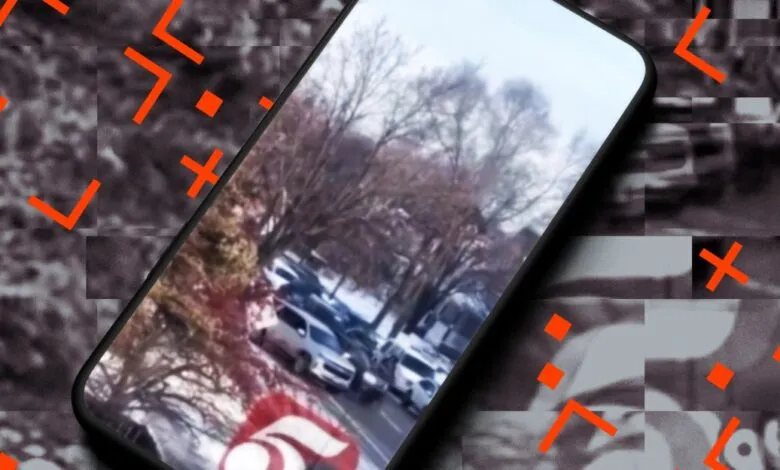
The specific clip shared by Trump, a grainy 13-second segment filmed from an elevated position partially blocked by a tree, has become a focal point for far-right commentary. Accounts like Libs of TikTok promoted it as “the video the Democrats don’t want you to see!” Despite its obscured view and inferior quality compared to other available footage, repeated sharing, editing, and zooming have given it an almost symbolic status. In today’s polarized media environment, this short clip serves as a piece of claimed incontrovertible proof for many, despite its visual limitations.
However, other videos from the scene contradict the official narrative. One witness recording from a different angle shows two agents approaching Good’s car, with one aggressively pulling on her door handle and shouting for her to exit. According to a neighbor who filmed the encounter, agents initially told Good to leave. Analysis of footage by The New York Times indicates that when Good put her car in reverse to turn away, the agent who fired was not in the vehicle’s path. Slowed-down clips suggest this agent was filming with a phone just before drawing his weapon. After three shots were fired, Good’s car accelerated down the street before crashing; the agent then walked toward the wreck and later left the scene.
Concerns often focus on how artificial intelligence might distort reality, and AI has played a role following this tragedy. Some users attempted to employ AI tools to generate fake identities for the masked shooter, with unconfirmed names spreading across social platforms. Yet the more immediate manipulation comes from the selective use of poor-quality video to construct a narrative, asking the public to disregard clearer contradictory evidence. The reliance on a single, blurry perspective demonstrates how a preferred angle can often achieve what AI deceptions might, shaping belief without complex technology.
This event echoes a painful history near the same location. Just a mile away, the video of George Floyd’s murder, recorded by teenager Darnella Frazier, sparked a global movement. While Officer Derek Chauvin was convicted, public debate still questioned the victim’s innocence and the scale of societal response. The power of video evidence remains undeniable, but its interpretation is fiercely contested. In a revealing recent image, an aide held up a laptop displaying the grainy, MAGA-promoted clip of Good’s shooting during an interview with Trump. When questioned about the discrepancies in his administration’s story, he deflected. For his base, the chosen clip confirms what they already believe to be true.
(Source: The Verge)