Can AI Read JavaScript ‘Hidden’ Content? An SEO Expert Answers
▼ Summary
– Googlebot processes JavaScript in three stages (crawl, render, index) and has improved at handling it, but rendering can be delayed as it’s resource-intensive.
– For both Googlebot and AI bots, interactively hidden content (like tabs) must be present in the initial page DOM to be reliably parsed, as bots cannot click to reveal it.
– Server-side rendering, which delivers pre-rendered HTML, is recommended to ensure content is accessible without requiring bots to execute JavaScript first.
– Unlike Googlebot, most major LLM bots (like those from OpenAI and Anthropic) currently cannot render JavaScript at all, requiring content to be in static HTML.
– SEOs can check content accessibility by inspecting the DOM in browser tools, using Google Search Console for Googlebot, and viewing page source HTML to confirm visibility for LLM bots.
Ensuring your website’s content is fully accessible to both traditional search engines and emerging AI systems presents a significant technical challenge for modern SEO. A key question arises around content delivered or hidden by JavaScript: can these new artificial intelligence crawlers parse it effectively? The answer reveals a crucial divergence in capabilities between established bots like Googlebot and the various agents scouring the web for large language models.
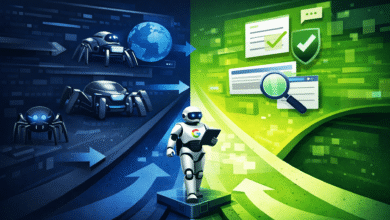
Googlebot processes JavaScript through a multi-stage system of crawling, rendering, and indexing. Initially, it discovers and queues pages, checking for any crawl blocks in robots.txt. If cleared, it proceeds to render the page. This rendering can be delayed as it’s resource-heavy, but Googlebot first receives a basic DOM response, the raw HTML before JavaScript runs. After executing the JavaScript, it obtains the final “browser render” of the page. Only then is eligible content stored in the index for search results.
A common issue involves interactively hidden content, like tabs or accordions. Googlebot cannot click buttons or switch tabs. For it to see this content, the information must exist within the initial page’s Document Object Model (DOM) upon first load. Visually, it can be hidden from the user, but the HTML must be present in the code from the start. Think of the HTML as being inside a locked box; JavaScript unlocks it. If the server unlocks the box beforehand, Googlebot can access the content immediately via the DOM.
To maximize the chance Googlebot reads your content, the goal is to make it accessible without requiring JavaScript rendering. A powerful method is server-side rendering (SSR). With SSR, the webpage is constructed on the server, and a complete HTML file is sent to the browser or bot. The content is immediately available in the HTML and CSS. This contrasts with client-side rendering, where the browser must fetch and compile JavaScript first. While easier on servers, client-side rendering forces bots to execute JavaScript to see any content, creating a potential barrier.
The landscape changes dramatically when considering the bots that gather data for LLMs. There is no single standard for how AI bots render JavaScript; capabilities vary widely between different companies. These crawlers, which build knowledge bases, operate differently from search engine bots that fetch timely results. Crucially, less is known about their processes as they don’t publicly share details like Google does. Independent investigations have provided critical insights.
Tests conducted in 2024 and reaffirmed more recently indicate that many prominent AI bots, including those from OpenAI, Anthropic, and Perplexity, cannot render JavaScript at all. The notable exceptions that can are bots like Gemini (using Google’s infrastructure), Applebot, and CommonCrawl’s CCbot. Given that even well-funded leaders struggle with JavaScript, it’s reasonable to assume smaller or niche AI crawlers face the same limitation.
Consequently, AI bots handle interactively hidden content poorly if it requires JavaScript execution. The safest approach is to ensure such content loads fully in the DOM without needing JavaScript. This allows human visitors to interact with it while guaranteeing bots can parse it from the initial code.
You can perform several technical checks to diagnose rendering issues. For Googlebot, start by examining the DOM through your browser’s Developer Tools. In Chrome, right-click, select “Inspect,” and go to the “Elements” tab. Search for your key content here upon the initial page load without any interaction. If you find it in the DOM at this stage, it should be visible to Googlebot. You can also use Google Search Console’s “URL Inspection” tool to test a live page and view exactly how Googlebot sees it.
Checking AI bot accessibility requires a different tactic. Following expert experiments, you can directly ask an LLM to read text from a specific webpage; it will often explain if JavaScript prevents access. For the most conservative assurance, assume LLMs cannot read JavaScript-rendered content and verify your critical text is in the static source HTML. Right-click on your page in Chrome and select “View page source.” Use the find function to locate your key text within this raw code.
The core takeaway is that Googlebot and AI crawlers are fundamentally different beasts with distinct capabilities. Googlebot has evolved sophisticated JavaScript handling, while most LLM bots currently lack this ability. They are not merely behind; they serve a different purpose. For your website, this means a dual strategy: ensure critical content is in the DOM on first load for Google, and confirm it resides in the static source HTML to guarantee access for the broadest range of AI systems.
(Source: Search Engine Journal)