Publishers’ Loss: How Google, YouTube, and X’s AI Shift Hurts Traffic
▼ Summary
– Google Discover is shifting from a publisher-first platform to an AI-driven one, with AI Summaries now constituting 51% of the feed in key test markets like the US, Brazil, and Mexico.
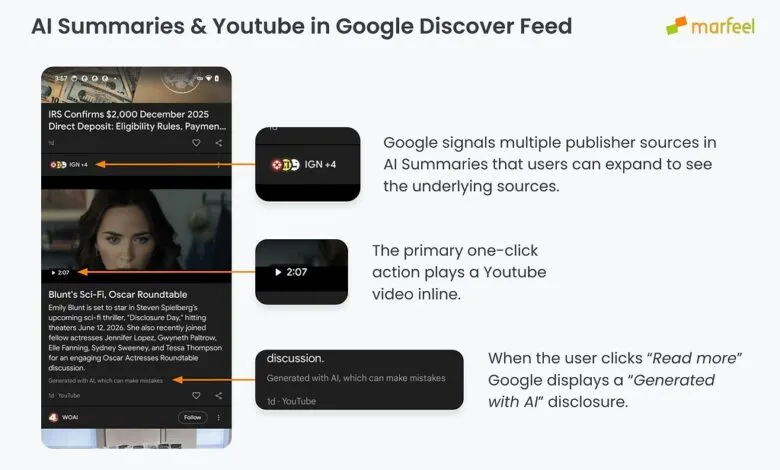
– AI Summaries often display multiple publisher logos but primarily direct users to a single default action, which in 77% of US cases is an inline YouTube video, reducing direct traffic to publishers.
– AI Summaries are concentrated in lower feed positions, making up over 82% of entries after position 20, indicating a rollout strategy that starts AI as backfill before potentially moving upward.
– YouTube is a major beneficiary, capturing a significant share of user engagement within Discover, while X (Twitter) content also appears frequently but mostly in lower-visibility positions.
– The changes suggest Discover is becoming an internal engagement layer for Google’s ecosystem, making it a volatile traffic source for publishers and turning test markets into precursors for a broader global redesign.
Recent data reveals a significant transformation in how Google Discover operates, moving away from its traditional role as a primary traffic source for news publishers. The platform is increasingly prioritizing its own ecosystem, particularly through AI-generated summaries and integrated YouTube videos, which are structurally reducing the number of clicks that reach external news websites. This shift represents a fundamental change in the digital content landscape, where visibility no longer guarantees audience engagement for publishers.
The core issue lies in the reallocation of feed real estate. Across key markets like the United States, Brazil, and Mexico, AI Summaries now constitute 51% of the Google Discover feed. This isn’t a minor interface tweak; it’s a substantial reengineering of the user experience. These summaries often display logos from several publishers, creating an illusion of broad sourcing. However, the default one-click action for users typically launches an inline YouTube video, not a visit to a publisher’s site. In the U.S., this happens 77% of the time, with a direct publisher link appearing in only 23% of cases. In Brazil and Mexico, the link within an AI Summary exclusively points to YouTube.
This creates a troubling dynamic for publishers: brand visibility without commensurate traffic. A news organization might be cited, but the user’s journey concludes inside Google’s walled garden. The data indicates this AI integration is being rolled out strategically. These summaries are not evenly distributed. In the U.S., they appear in just 21.6% of the coveted top five feed positions but skyrocket to 82.7% of entries after position twenty. This “colonization of the long tail” suggests Google is testing AI content where user viewability is naturally lower before potentially moving it upward, systematically squeezing publishers out of volume exposure.
The clear beneficiary of this redesign is YouTube. The platform is absorbing a material share of Discover positions, often serving as the sole exit point from an AI Summary. This evolution signals Google Discover’s transition from a traffic distributor to an engagement retention layer designed to keep users within its own suite of services. Concurrently, content from X (formerly Twitter) is appearing with growing frequency, though mostly in lower feed positions. While individual X posts may have limited visibility, in aggregate they command significant feed real estate.
The economic implications for publishers are severe. Traffic from Discover is becoming more volatile and prone to sudden drops as AI blocks replace traditional article links in chunks. Visibility without clicks fails to build direct audience relationships through newsletters, accounts, or subscriptions. Furthermore, editorial return on investment becomes harder to calculate when content primarily fuels AI answers or YouTube viewing sessions without generating monetizable outcomes for the newsroom.
The current changes in the U.S., Brazil, and Mexico are likely not isolated experiments but test markets for a broader global rollout. The multi-icon, single-link model establishes a pattern of perceived attribution without delivering equivalent visitor traffic. As Google continues its country-by-country experimentation, instability for publishers will persist. The overarching trend is clear: Google Discover is shifting from a reliable growth engine for publishers to a volatile dependency that functions as an attention controller. While currently focused on YouTube and X, Google’s references to other platforms like Facebook, Instagram, and TikTok suggest the feed may soon incorporate even more social content, further diluting the presence of traditional news publishers.
(Source: Marfeel)