Nvidia’s DLSS 4.5: The Gamer’s Win at CES 2026
▼ Summary
– Nvidia has released DLSS 4.5, its latest AI-powered graphics upgrade, which is available today for hundreds of compatible PC games to enhance performance and image quality.
– The technology works by initially rendering a game at a lower resolution for higher frame rates, then using a trained neural network to upscale the image to a target resolution that closely matches native quality.
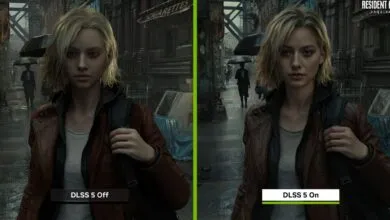
– A key upgrade in DLSS 4.5 is an improved second-generation Super Resolution Transformer model, offering better image stability, reduced ghosting, and smoother edges, especially on RTX 40 and 50 series cards.
– The update also controversially enhances Multi Frame Generation (MFG), allowing RTX 50-series GPUs to generate up to six AI frames between game frames, theoretically boosting a 60fps base to 360fps.
– While DLSS is Nvidia’s proprietary tech, similar upscaling exists elsewhere, and over 250 games and apps support DLSS4, making it a widely adopted feature in new PC gaming releases.
While the PC graphics hardware market faces challenges with high prices and fluctuating availability, the software side continues to advance steadily. Nvidia’s announcement of DLSS 4.5 at CES 2026 represents a significant software-driven win for gamers, offering immediate performance and image quality enhancements across a vast library of compatible titles. This latest evolution of the company’s AI-powered upscaling technology is available now, providing tangible benefits for a wide range of GeForce RTX hardware owners.
For those unfamiliar, DLSS, or Deep Learning Super Sampling, is an AI technology designed to boost both frame rates and visual fidelity. The core concept involves rendering a game at a lower internal resolution to achieve higher performance, then using a specialized neural network to intelligently upscale the image to your monitor’s target resolution. The result aims to deliver performance close to the lower resolution with image quality approaching that of a native, higher-resolution output. This technique has become a cornerstone of modern gaming, especially valuable when enabling demanding features like real-time ray tracing that can severely impact performance.
Nvidia’s proprietary system is the industry leader, though alternatives exist like AMD’s FidelityFX Super Resolution and PlayStation’s PSSR. The technology’s value is clear: it allows hardware to stretch further, and for many players, the upscaling process is virtually imperceptible, making high-fidelity gaming more accessible.
DLSS 4.5 introduces two major upgrades. The first is a refined second-generation “Super Resolution Transformer” model. This enhanced AI upscaler promises superior image quality with greater stability, reduced visual artifacts like ghosting, and cleaner edges, particularly in complex scenes with fast motion or fine distant details. Nvidia now positions this transformer model as its definitive best offering. Crucially, while it delivers the full experience on GeForce RTX 40 and 50 series cards, owners of older RTX 20 and 30 series GPUs will also see benefits from DLSS 4.5, a welcome inclusion given current upgrade costs.
The second, more debated enhancement is to Multi Frame Generation (MFG). This feature goes beyond upscaling by using AI to generate entirely new frames inserted between those rendered by the game engine, creating a smoother perceived motion. The DLSS 4.5 upgrade dramatically increases this capability. Where the initial version could generate up to four frames between game frames, the new version pushes that limit to six. In theory, this could transform a 60fps base into a 360fps output. Accompanying this is a new dynamic setting, allowing users to set a target frame rate and let the GPU automatically adjust the MFG multiplier to hit it.
It’s important to note that the full 6X MFG capability is exclusive to the latest RTX 50-series graphics cards and is slated for a Spring release. Utilizing any DLSS feature, of course, requires an Nvidia RTX GPU and game support. The company emphasizes strong developer adoption, noting that DLSS 4 is supported in over 250 games and applications, including a majority of 2025’s major new releases.
At a CES event where Nvidia’s focus often leaned toward broader AI ambitions, DLSS 4.5 stands out as a direct commitment to the gaming community. It delivers concrete, usable improvements that enhance the experience for players right now, provided they can access the supporting hardware. This continued refinement underscores how AI-driven software is becoming just as critical as raw silicon in defining the modern gaming landscape.
(Source: Eurogamer)