Commonwealth Fusion Installs Reactor Magnet, Secures Nvidia Deal
▼ Summary
– Commonwealth Fusion Systems (CFS) has installed the first of 18 powerful magnets for its Sparc fusion reactor, which it aims to activate next year.
– These magnets will create a magnetic field to confine superheated plasma, with the goal of achieving a net energy gain where more energy is released than used.
– Each massive magnet weighs 24 tons and can generate a 20 tesla field, requiring cooling to -253°C to safely conduct over 30,000 amps of current.
– CFS is developing a digital twin of the reactor with Nvidia and Siemens to simulate experiments and optimize performance before applying changes to the physical device.
– The company has raised nearly $3 billion to date, with its first commercial plant, Arc, estimated to cost several billion more, as it races to deliver fusion power to the grid in the early 2030s.
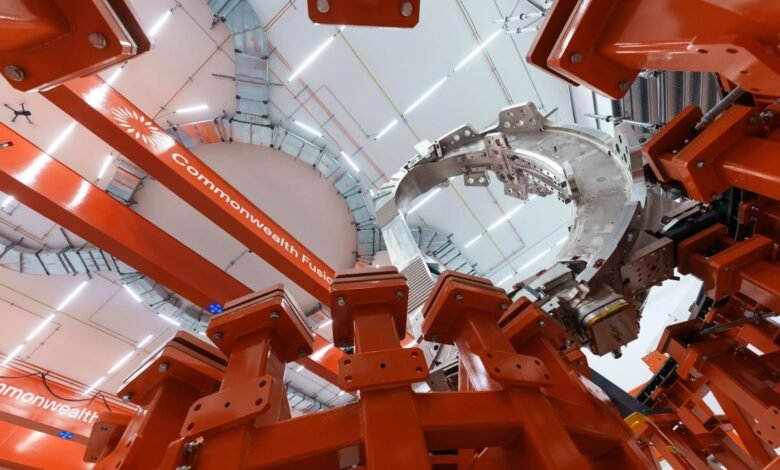
A major milestone in the quest for commercial fusion energy has been reached with the installation of the first reactor magnet at Commonwealth Fusion Systems. The company announced the progress at CES 2026, marking a critical step toward powering up its Sparc demonstration reactor next year. This device is central to a global race aiming to deliver the first fusion-generated electricity to power grids in the early 2030s, promising a transformative source of nearly limitless clean energy.
The newly installed magnet is the first of eighteen that will ultimately form a doughnut-shaped chamber, known as a tokamak. Inside, a powerful magnetic field will confine and compress superheated plasma to temperatures exceeding 100 million degrees Celsius. The goal is to achieve a net energy gain, where the fusion reactions release more power than is required to initiate and sustain them. According to CFS co-founder and CEO Bob Mumgaard, key magnet components are finished, and the team plans to install all eighteen units by the end of the coming summer. He described the process as moving quickly, stating the assembly will proceed “bang, bang, bang throughout the first half of this year.”
These are not ordinary magnets. Each one is a D-shaped behemoth weighing 24 tons, capable of generating an immense 20 tesla magnetic field. For perspective, that’s roughly thirteen times stronger than the field in a standard hospital MRI machine. Mumgaard likened its power to something that could “lift an aircraft carrier.” The magnets will be mounted upright on a massive 75-ton stainless steel base called a cryostat, which was positioned last March. To operate safely at such extreme strengths, the magnets must be supercooled to a frigid -253 degrees Celsius, allowing them to conduct over 30,000 amps of electrical current.
In a parallel development aimed at de-risking the project, CFS has secured a partnership with Nvidia and Siemens to create a comprehensive digital twin of the entire Sparc reactor. While the company has already run countless isolated simulations for individual components, this new model will be a living, synchronized virtual replica. Siemens is providing advanced design and manufacturing software to gather data, which will then feed into Nvidia’s Omniverse platform. “These are no longer isolated simulations that are just used for design,” Mumgaard explained. “They’ll be alongside the physical thing the whole way through, and we’ll be constantly comparing them to each other.” This approach allows engineers to conduct virtual experiments and adjust parameters digitally before implementing changes on the actual hardware, accelerating the learning process.
The scale of investment matches the ambition of the technology. To date, Commonwealth Fusion Systems has raised close to $3 billion, including an $863 million funding round last August that saw participation from Nvidia, Google, and numerous other investors. The path forward remains capital-intensive; the company estimates its first full-scale commercial plant, named Arc, will require several billion dollars more to construct. Mumgaard believes tools like digital twins and advancing AI will be crucial for streamlining development and meeting urgent climate goals. He noted that as machine learning tools improve and digital representations become more precise, the pace of innovation can increase, helping to bring fusion power to the grid sooner.
(Source: TechCrunch)
