ChatGPT’s New Image Feature: A Stunning, Fun Upgrade
▼ Summary
– OpenAI has released a major update to ChatGPT’s image generation, called ChatGPT Images or GPT Image 1.5, making it available across all tiers including free.
– The new feature excels at accurate recontextualization, allowing detailed edits to uploaded images while maintaining realistic results and avoiding an uncanny valley effect.
– It demonstrates significantly improved text rendering within images, which has historically been a challenge for AI image generators.
– During testing, the tool successfully followed complex prompts for creative edits but also made unrequested subtle changes to elements like camera angle, expression, and composition.
– The author concludes the update is a definite and fun improvement over previous capabilities, with excellent text handling, though notes some interface quirks like a blurring generation effect.
The latest upgrade to ChatGPT’s image generation capabilities marks a significant leap forward, offering users a powerful and surprisingly accurate tool for creating and editing visuals. This new feature, now accessible across all subscription tiers including the free version, demonstrates a clear focus on improving text rendering and intelligent image recontextualization. While the underlying model has seen a substantial refresh, the real-world results showcase a system that understands context and executes edits with a newfound level of precision, avoiding the unsettling “uncanny valley” effects that often plague AI-generated art.
A core strength of the updated system is its ability to take a starting image and intelligently modify it based on a user’s prompt. For instance, when provided with a photograph of a person on a park path and asked to place the subject in a red shirt with a specific logo, the tool executed the request flawlessly. It accurately rendered the stylized text of the logo and integrated the new clothing seamlessly. However, it also made several unrequested adjustments, such as altering the subject’s facial expression, shifting the camera perspective, and modifying background elements like tree placement and shadows. Despite these autonomous changes, the final output remained coherent and visually natural.
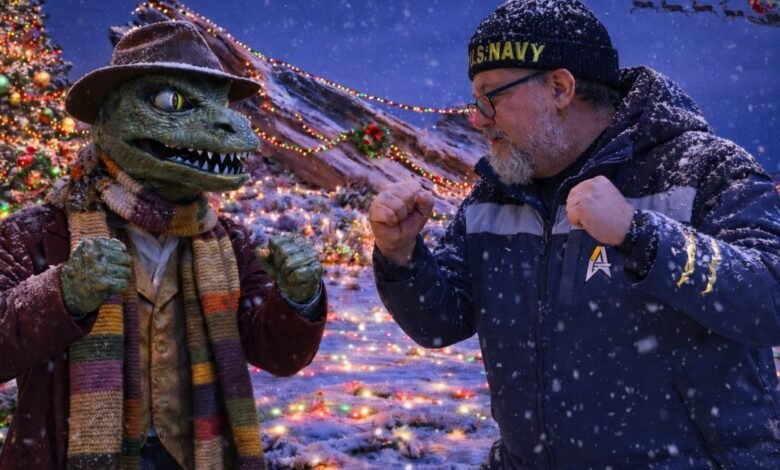
The fun truly begins when pushing the tool’s creative boundaries. Using the same base image, a series of playful prompts transformed the scene into a homage to classic science fiction. The AI successfully placed the subject in front of the iconic Vasquez Rocks filming location, composited a classic Star Trek Gorn creature into the foreground, and even staged a confrontation between the two. The tool consistently managed lighting and shadows to match the new environments, lending credibility to the composite images.
Further experiments highlighted both the tool’s capabilities and its occasional quirks. When instructed to dress the subject in a Starfleet captain’s uniform, it correctly generated the iconic gold shirt but curiously demoted the rank by omitting a sleeve stripe. More whimsical prompts, like dressing the Gorn in Doctor Who attire or transforming the desert scene into a snowy Christmas party, were handled with creative flair. The system adeptly added festive decorations, adjusted lighting for a twilight ambiance, and even generated themed text for a custom holiday party invitation. The ability to handle complex, layered requests while maintaining contextual awareness is particularly impressive.
This iteration represents a major improvement over previous versions, especially in its handling of text within images, a traditional weak spot for AI generators. The process is relatively quick, though the visual “blurring” effect during generation could be distracting for some users. Overall, this upgrade transforms ChatGPT into a remarkably versatile and entertaining creative partner. Its strength lies not just in generating images from scratch, but in intelligently and faithfully editing existing visuals, opening up new possibilities for both practical design and pure imaginative play.
(Source: ZDNET)