Navigating Hyper Uncertainty: The New Leadership Imperative for the C-Suite
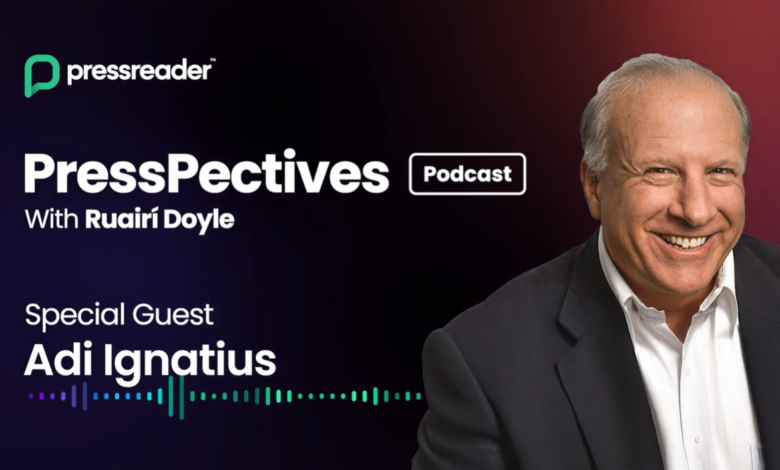
What does a senior leader need to succeed in a world of constant disruption? According to Adi Ignatius, the long-time Editor-in-Chief of Harvard Business Review, the answer lies not in more information, but in better, more trusted insight. Joining host Ruairí Doyle, CEO of PressReader, on episode #8 of The PressPectives Podcast, Ignatius dives into the challenges of leading through what he calls “hyper-uncertainty”, an environment where traditional models of leadership and strategy are frequently upended. In this conversation, they discuss why the demand for clarity, practical guidance, and evidence-based thinking has never been higher for the modern C-suite.
The Evolution of Business Thought Leadership
For decades, Harvard Business Review has served as a cornerstone of management thinking. However, Ignatius notes a significant shift in the needs of its core audience. Today’s executives are inundated with content from countless sources, making it difficult to separate signal from noise. The value proposition of a publication like HBR, therefore, must evolve beyond simply publishing articles. It must curate, synthesize, and deliver knowledge in formats that are immediately applicable to the immense pressures leaders face. This means moving from broad business journalism to targeted executive education, providing tools that help leaders make decisive moves in complex situations.
This recognition led directly to the creation of HBR Executive, a new platform designed specifically for the senior leadership tier. The initiative addresses a clear gap in the market. While there is no shortage of management advice, much of it is either too theoretical for immediate application or too simplistic for the nuanced challenges of the C-suite. HBR Executive aims to bridge that divide by offering concise, evidence-based insights in a structured, accessible format. The goal is to save executives time while deepening their strategic capabilities.
Inside HBR Executive: A Toolkit for Modern Leaders
The platform is built around several key components, each tailored to the workflow and learning preferences of busy executives. A central feature is a suite of focused newsletters that distill essential research and trends into actionable briefings. Beyond written content, the platform offers interactive masterclasses and playbooks. These resources translate Harvard Business Review’s renowned case studies and frameworks into step-by-step guides for tackling specific business problems, from navigating geopolitical risk to restructuring teams for innovation.
Perhaps most importantly, HBR Executive incorporates live virtual events that foster direct connection and dialogue. These sessions allow leaders to engage with HBR editors, faculty, and fellow executives, creating a community of practice where they can test ideas and share experiences. This multifaceted approach, combining timely analysis, practical tools, and peer interaction, reflects a holistic understanding of how executive development happens today. It is learning designed for application, not just consumption.
Enduring Lessons from Leadership’s Front Lines
Drawing from his extensive career interviewing and profiling the world’s most influential leaders, Ignatius highlights several philosophies that remain profoundly relevant. He recalls Jack Welch’s intense focus on ownership and accountability, a mindset that drove performance by making leaders feel personally responsible for their units as if they were their own businesses. This principle of empowered ownership continues to be a powerful driver of results in decentralized, agile organizations.
In stark contrast, yet equally powerful, is the lesson from Microsoft CEO Satya Nadella. Ignatius points to Nadella’s conviction that empathy is a business imperative. Nadella transformed Microsoft’s culture by arguing that understanding customer and employee needs is not a soft skill, but the very foundation of innovation and growth. This shift from a know-it-all to a learn-it-all culture underscores how emotional intelligence and a growth mindset are critical for leading in the digital age. These two examples, from different eras and styles, illustrate that effective leadership is not about a single formula, but about applying core principles with contextual intelligence.
The Unchanging Core: Trust and Practical Value
Amidst all the change in media and business, Ignatius emphasizes that certain fundamentals are non-negotiable. For a publication like Harvard Business Review, building and maintaining trust is paramount. In a landscape filled with speculation and opinion, executives turn to sources that are rigorous, fact-based, and free from undisclosed bias. This trust is earned through a relentless commitment to quality and a focus on what truly helps leaders perform their jobs better.
Ultimately, the measure of success for any thought leadership platform is the practical value it delivers. Whether it’s a framework for a difficult conversation, a strategy for entering a new market, or insight into an emerging technology, the content must translate into tangible leadership action. This is the guiding principle behind HBR’s evolution and the launch of HBR Executive. It is a response to a clear demand: leaders need partners in learning who can provide not just information, but wisdom, clarity, and trusted guidance for the path ahead. In an era of hyper uncertainty, that partnership may be one of the most strategic assets a leader can cultivate.