Build Trust to Boost Your Online Visibility
▼ Summary
– Attention is fragmenting across a growing number of platforms, including AI search and social networks, making the information environment noisier.
– People are drowning in information and increasingly distrust traditional sources, so they cross-check findings across multiple platforms before making decisions.
– Searching is fundamentally a trust experience involving three layers: self-trust, platform trust, and source trust, with people often turning to other people for trusted advice.
– Modern search journeys now span dozens of sources, with research showing consumers heavily use and cross-check multiple platforms, and they place high trust in people-led sources like communities.
– To gain visibility, brands should focus on building genuine trust in people-led spaces like communities and events, as visibility on search platforms becomes a byproduct of that earned trust.
The digital landscape is increasingly fractured, with attention divided across a growing number of platforms from AI search tools to private social communities. In this crowded and often noisy environment, a fundamental shift is occurring: trust in traditional information sources is eroding. While people still use search engines and social media for initial research, they increasingly turn elsewhere for validation. The most reliable source, it seems, is returning to the forefront, other people. For brands, this means achieving visibility requires a presence not just on platforms, but within the human conversations happening across them.
At its core, searching is a trust experience. As expert Rachel Botsman defines it, trust is “a confident relationship with the unknown.” We search when we are uncertain, navigating three distinct layers: self-trust (acknowledging our own uncertainty), platform trust (choosing where to look), and source trust (deciding which information to act upon). The entire process is driven by a human need for confidence, which is increasingly fulfilled by other humans rather than faceless algorithms.
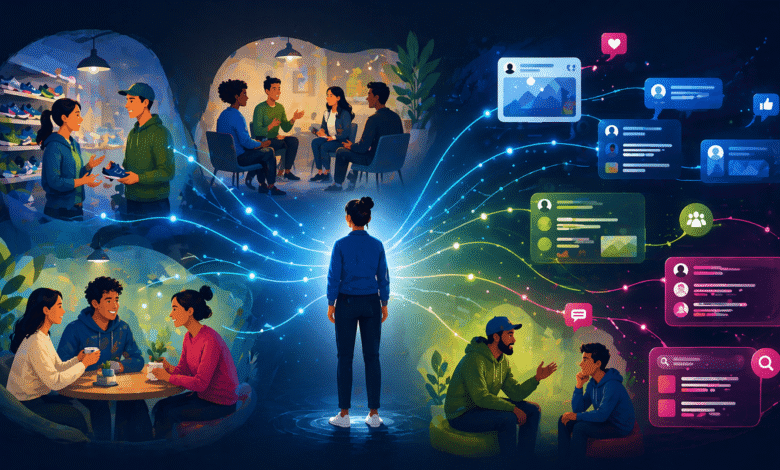
Consider a modern search journey, like buying a pair of running shoes. It might begin with low-trust queries in AI chatbots to generate options, move to medium-trust sources like review sites and Reddit threads, and ultimately culminate in high-trust consultations with friends, a running community, or a specialist in a store. This path is no longer linear or confined to a single website. Research from Yext in 2025 found that approximately 75% of consumers use new search tools more than they did a year ago, and nearly half cross-check answers across multiple platforms. A single decision can easily involve dozens of touchpoints.
The data underscores this human-centric shift. In professional contexts, a LinkedIn-commissioned study revealed that 43% of people rate their professional network as their most trusted source, ahead of search engines and AI tools. The 2026 Edelman Trust Barometer further highlights a broader trend of rising uncertainty, with individuals placing greater trust in those closest to them. The implication for visibility is clear: to be found, you must be present in all the platforms people use and, more importantly, within as many people-led sources as possible.
The most effective strategy reverses the conventional playbook. Instead of focusing solely on platform algorithms, begin by building genuine trust with people. Earn positive mentions in communities, forums, and social conversations. This human validation is what modern search platforms, including AI tools, are increasingly designed to surface. Analyses of billions of AI citations show that platforms like ChatGPT and Google AI Overviews systematically prioritize human conversation to build trust. Visibility becomes a natural byproduct of earned credibility.
Take Adidas Terrex as an example. The brand’s visibility across a consumer’s search journey, from Reddit forums to AI results, stems from active trust-building activities. By sponsoring running clubs, hosting events with partners like the Underground Fan Club, and engaging authentically, they generate hundreds of organic social posts and community discussions. These people-led mentions are then captured and amplified by search platforms, creating a powerful visibility loop.
To start this process, identify where your audience builds trust. Prioritize environments with strong trust-building components: spaces that facilitate smooth, two-way conversations; allow for consistent presence; cater to specific, niche interests; and encourage authentic, non-anonymous participation. Communities and events often offer the strongest trust-building potential, while social media and forums provide lower-barrier entry points with slightly weaker components.
Engagement in these spaces must be guided by a principle of helping, not selling. Start by listening intently to understand both the enduring needs of the community and the timely topics of conversation. Then, engage in 1:1 conversations to provide genuine assistance, showing up consistently as a real person, not just a brand representative. From these interactions, you can identify common pain points and scale your help through created assets. The key is to design these resources as mention power-ups, tools that help individuals showcase a desired identity or achievement, making them eager to share and tag your brand.
The business impact is tangible. One SEO SaaS platform, by embedding itself in a community, listening to members’ desire for amplification, and providing consistent help, transformed trust into visibility. They developed a scaled guest-posting program based on community feedback, featured members in their content, and generated over £50,000 in new annual revenue. This demonstrates that a help-first mindset ultimately drives commercial results.
Building trust is a long-term visibility strategy that transcends any single algorithm update or new platform. By making trust a core strategic pillar, you future-proof your visibility, ensuring your brand is present in AI search today and whatever emerges tomorrow. Shift from chasing algorithmic changes to fostering genuine human relationships, and visibility will follow.
(Source: Search Engine Land)