The Landlord Algorithm: Why Your Website is the Only Asset That Will Survive 2026
▼ Summary
– A website is essential for long-term brand building, serving as a “Digital Fortress” for data sovereignty and control, unlike rented social media platforms.
– Google experts warn that a bad website damages trust more than having none, and owning your site prevents algorithmic content suppression.
– A professional website acts as a critical trust and verification tool, with most consumers researching off-platform before major purchases.
– Without a website, your brand is invisible to AI models like ChatGPT, which crawl the open web to determine expertise and make recommendations.
– Relying solely on social media is risky due to platform instability and bans; a website is necessary for selling complex services and controlling the user journey.
It’s a valid question. You can build a six-figure business on Instagram. You can run a community entirely on WhatsApp. You can sell directly through TikTok Shop. In a world where 60% of Google searches are now “Zero-Click”, meaning the user never leaves the search results page, the traditional website feels like a relic.
But if you ask the architects of the internet (Google) and the masters of modern marketing (Godin, Patel), the answer is a resounding, terrifying yes. But not for the reasons you think.
The era of the website as a “traffic magnet” is dead. The era of the website as a “Digital Fortress” has just begun.
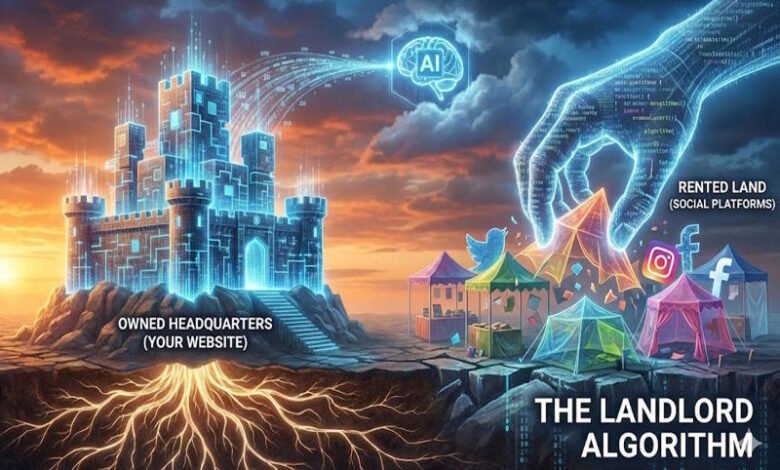
1. The Google Verdict: “Owned House” vs. “Rented Land”
In a revealing 2026 episode of Google’s Search Off the Record, search analysts Gary Illyes and Martin Splitt tackled this exact question. Their answer wasn’t a blind “yes.” It was a nuanced warning.
They admitted that for hyper-niche projects, like a mobile game or a local community group, a website might be optional. However, for anyone building a long-term brand, Illyes made a critical distinction between capability and trust.
- The “Spam” Paradox: Illyes noted that a bad website is actually worse than no website. He would trust a curated social media profile over a broken, non-HTTPS site.
- The Control Factor: On social media, you are a tenant. You cannot build custom tools, complex calculators, or nuanced service pages without the platform hiding your content. As Splitt noted, on your own site, “The algorithm doesn’t hide it from me.”
The Takeaway: Social media is for distribution; your website is for data sovereignty. If you don’t own the URL, you don’t own the business.
2. The “Verification” Check
Imagine you find a consultant on LinkedIn. Their posts are brilliant. They have 50,000 followers. You are ready to hire them for a $10,000 contract.
What is the first thing you do? You Google them.
If they don’t have a website, or if their website looks like it was built in 2014, the trust evaporates. In 2026, a website acts as a digital background check.
- Seth Godin’s “Enrollment”: The marketing legend argues that social media is where you make noise, but the website is where you get “enrollment”, permission to market to someone long-term (via email or data pixels).
- The Stat: Despite the rise of social commerce, 81% of consumers still perform off-platform research before making a significant purchase.
3. Survival in the Age of AI
Here is the threat no one talked about three years ago: AI Visibility.
Tools like ChatGPT, Claude, and Google Gemini are becoming the new search engines. These Large Language Models (LLMs) are trained on the open web. They “read” websites to learn who is an expert and who isn’t.
- Neil Patel’s Warning: If your content exists solely on Instagram or locked behind a LinkedIn login, it is invisible to many AI training crawlers.
- The Consequence: When a user asks an AI, “Who is the best crisis PR firm in Dubai?”, the AI will recommend the firms it “knows” from authoritative websites. If you don’t have a website, you don’t exist in the AI’s memory.
4. The “Rented Land” Economy
Gini Dietrich, creator of the PESO model (Paid, Earned, Shared, Owned), has long warned about “Digital Sharecropping.”
We have seen X (Twitter) degrade. We have seen TikTok face bans. We have seen organic reach on Facebook drop to near zero. These platforms are walled gardens. You are there at the mercy of the landlord.
- The Shift: You cannot effectively sell high-ticket items, B2B services, or complex products in a 60-second video. You need an environment free of distractions, a place where you control the user journey, not an algorithm designed to make users scroll away.
The Verdict
Do you need a website to get a million random visitors? No.
Do you need a website to build a legally secure, asset-backed, AI-proof brand? Absolutely.
Stop treating your website like a billboard. Start treating it like your headquarters. You can rent attention on social media, but you must own your reputation on the web.