BMW Retires Humanoid Robots After 11-Month Trial
▼ Summary
– Figure AI has retired its Figure 02 humanoid robots after an 11-month deployment at BMW’s Spartanburg plant, where they assisted in producing over 30,000 BMW X3 vehicles and loaded more than 90,000 sheet-metal parts.
– The robots showed visible wear and tear, including scratches and grime, which the company presented as proof of real-world industrial use and to counter skepticism about the deployment’s scale.
– During the trial, the robots achieved high performance, handling metal loading with 99% accuracy, an 84-second cycle time, and over 1,250 hours of runtime while walking approximately 200 miles in the facility.
– Hardware challenges were identified, with the forearm being a key failure point due to complex components and constant motion, leading to design improvements in the next-generation Figure 03 model.
– The retirement of Figure 02 marks a transition from pilot testing to scaled deployment, with Figure 03 incorporating lessons learned and being positioned for broader industrial use.
BMW’s recent 11-month trial with humanoid robots has concluded, marking a significant step in the integration of advanced robotics within active automotive assembly lines. The California robotics firm Figure AI has officially retired its Figure 02 (F.02) fleet following an extensive deployment at the BMW Manufacturing plant in Spartanburg, South Carolina. This pilot program was designed to rigorously test the capabilities of humanoid robots in a real-world production environment.
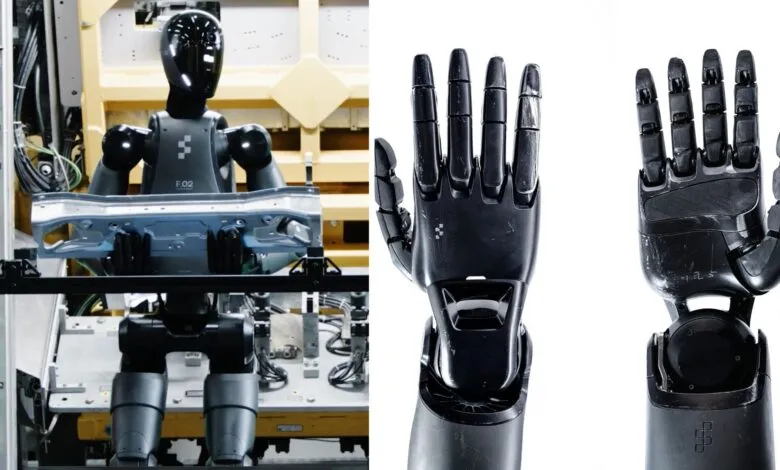
Throughout the trial, the F.02 units played a direct role in manufacturing, contributing to the assembly of over 30,000 BMW X3 vehicles. Their duties specifically involved handling and loading more than 90,000 sheet-metal parts onto the production line. The company’s CEO, Brett Adcock, shared images and videos that vividly displayed the robots covered in scratches, scuffs, and a layer of industrial grime. This visible wear and tear was presented not as a flaw, but as proof of concept, a testament to the machines enduring the demanding, repetitive nature of factory work over a sustained period. The company emphasized that this evidence counters any perception that the project was merely a small-scale feasibility study.
Performance data released from the trial provides concrete metrics on the robots’ contributions. After an initial setup phase, the F.02 units were integrated onto the factory floor within six months. By the tenth month, they were operating full shifts. Their primary function was to lift sheet-metal parts from bins and position them onto welding fixtures with a precise 5-millimeter tolerance. Following this placement, conventional robotic arms would perform the welding. The humanoids achieved this loading task with a cycle time of 84 seconds and maintained an accuracy rate exceeding 99 percent. In total, the fleet accumulated more than 1,250 hours of runtime, with an estimated walking distance of 200 miles inside the facility, all while adhering to a standard 10-hour shift schedule from Monday to Friday.
The deployment was not without its technical challenges, offering valuable lessons for future development. The forearm of the robot emerged as the primary failure point. Engineers identified that packing three degrees of freedom, thermal management systems, and necessary cabling into a human-sized limb created significant stress on microcontrollers and wiring during constant motion. These hardware insights have directly influenced the design of the next-generation model, the Figure 03. The new design eliminates the distribution board and dynamic cabling in the wrist, opting instead for motor controllers that communicate directly with the main computer.
The retirement of the Figure 02 fleet signifies a pivotal transition from pilot testing to preparing for broader implementation. The company stated that the F.02 model provided the foundational “early lessons on what it takes to ship” a viable product. With this phase complete, the path is now clear for the scaled deployment of the more advanced and robust Figure 03 humanoid robots.
(Source: Interesting Engineering)