Exowatt’s Hot Rocks Could Power AI Data Centers
▼ Summary
– Exowatt aims to solve AI’s power crisis by targeting solar energy at one cent per kilowatt-hour through modular, container-sized units with thermal storage.
– The company raised an additional $50 million in funding to scale production toward its cost goal, building on strong market momentum and investor interest.
– Each P3 unit uses concentrated solar power to heat special bricks, storing thermal energy for up to five days and generating electricity via a Stirling engine and generator.
– Exowatt’s approach focuses on simplicity and modularity, differentiating it from past solar thermal projects by emphasizing scalable manufacturing and learning curves.
– While best suited for sunny regions and requiring significant land, Exowatt sees high demand overlap with new data center locations and has a backlog of 10 million units.
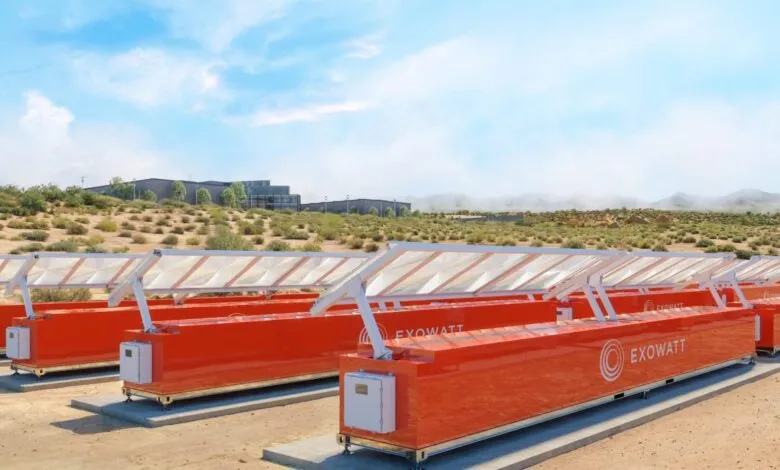
Finding a reliable and affordable energy source for the massive power demands of artificial intelligence data centers presents a significant challenge. Exowatt, a company founded by Hannan Happi, is tackling this issue head-on with an innovative approach centered on a single, ambitious goal: delivering electricity for just one cent per kilowatt-hour. After extensive research and development, the company’s initial solution is a modular unit resembling a shipping container, topped with a clear awning. The internal design is intentionally straightforward. If Exowatt succeeds in its mission to provide inexpensive, around-the-clock solar power, it could fundamentally reshape the data center industry and the wider energy sector.
To accelerate production and chase that one-cent target, Exowatt has secured an additional $50 million. This funding extends a $70 million Series A round that was finalized earlier this year. The investment was spearheaded by MVP Ventures and 8090 Industries, with support from a consortium of firms including Atomic, BAM, and Bay Bridge Ventures. Previous backers like Andreessen Horowitz and Sam Altman also remain involved. Happi noted that while the company wasn’t actively seeking more capital after its April round, compelling market momentum and intense investor enthusiasm convinced them to accept the new funds at a higher valuation.
The company’s current order backlog is substantial, representing about 10 million of its P3 units, which translates to 90 gigawatt-hours of energy capacity. Happi’s vision is to scale production rapidly, aiming first for millions of units and ultimately reaching billions. He believes the one-cent-per-kilowatt-hour price point will become achievable once annual production scales to approximately one million units.
The technology powering Exowatt’s system is a modern take on a classic concept known as concentrated solar power. This method uses sunlight to heat materials that are exceptionally good at storing thermal energy. For long-duration storage, these materials often resemble or are derived from rocks, lending the technology its “rocks in a box” nickname. Each P3 module is a metal box fitted with lenses that concentrate sunlight into an intense beam. This beam heats a specialized brick housed inside the container. A fan then circulates air over the hot brick, transferring the heat to a separate unit containing a Stirling engine, a piston-based device that converts heat into mechanical energy, and a generator. The entire system is engineered for extreme simplicity and scalability, with more boxes added to increase power storage.
A key advantage is the thermal battery’s ability to retain heat for up to five days, guaranteeing continuous operation even when the sun isn’t shining. Multiple P3 units can be linked together to supply a single generator, with the quantity tailored to a client’s specific electricity needs. According to Happi, the system’s overall efficiency matches that of traditional photovoltaic solar panels and even slightly surpasses the combination of PV panels with lithium-ion batteries.
While other companies have explored similar thermal solar technologies, many have struggled to compete with the rapidly falling costs of photovoltaics and lithium-ion batteries. Happi argues that Exowatt’s differentiation lies in the P3’s compact, modular design and the company’s focus on iterative manufacturing improvements. He points out that globally, there are just over 100 concentrated solar power projects in various stages, a tiny number compared to the 1.5 billion solar panels manufactured annually. This disparity highlights a vast gap in manufacturing learning curves.
Exowatt’s strategy is to take a modular system with a proven working principle and apply massive-scale manufacturing to drive down costs through learning and efficiency gains. The technology does have limitations; it may not be cost-effective in every location and powering a large data center would require significant land area. Its performance is also optimal in sun-drenched regions, which could restrict its global applicability.
However, Happi emphasizes a strong geographical correlation between the areas where the P3 system performs best and the locations where new data centers are being constructed. He confidently states that the company has no shortage of potential projects, indicating a ready market for their innovative power solution.
(Source: TechCrunch)