Solar Flare Delays Jeff Bezos’ New Glenn Rocket Launch
▼ Summary
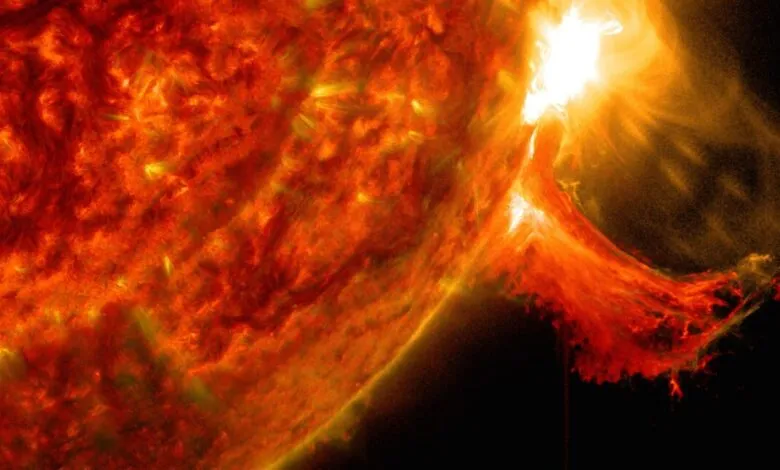
– Blue Origin’s New Glenn rocket launch was postponed due to a solar storm that raised concerns about impacts on communications, navigation, and power grids.
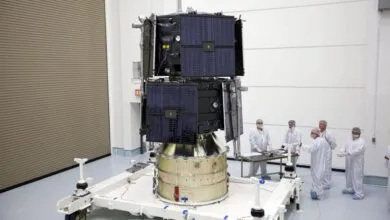
– NASA decided to delay the mission to protect its two ESCAPADE spacecraft, which are destined for Mars, from potential damage by high-energy solar particles.
– This marks the second flight of Blue Origin’s New Glenn rocket, which includes plans to recover the reusable first stage booster in the Atlantic Ocean.
– Rocket launch delays due to space weather are rare but have occurred before, such as with an Antares rocket in 2014 and a SpaceX Falcon 9 in 2023.
– A new launch date for the ESCAPADE mission has not been set, with potential scheduling conflicts from other planned launches at Cape Canaveral possibly pushing it to the weekend.
The second launch attempt of Blue Origin’s New Glenn rocket was called off Wednesday as a powerful solar storm swept over Earth, creating brilliant auroras and raising concerns about disruptions to communications, navigation systems, and power infrastructure. Such intense solar activity can interfere with satellite functions, which is precisely why NASA opted to delay sending its two ESCAPADE science probes to Mars aboard the New Glenn from Cape Canaveral Space Force Station in Florida.
Blue Origin confirmed the postponement in a public statement, noting that while the New Glenn vehicle stands ready for flight, NASA, the mission’s customer, made the decision to wait for improved space weather conditions. The company explained that highly elevated solar activity could potentially affect the ESCAPADE spacecraft, and teams are now evaluating the next available launch window based on space weather forecasts and range scheduling. Blue Origin, founded by Jeff Bezos, aims to recover the rocket’s reusable first stage booster on an ocean platform after liftoff.
Delaying a launch due to space weather is uncommon but not unheard of. In 2014, an Antares cargo mission to the International Space Station was postponed for one day because of heightened solar activity. More recently, in 2023, SpaceX delayed a Falcon 9 launch for several hours until space radiation levels decreased. This caution follows an earlier incident in which a geomagnetic storm caused Earth’s atmosphere to expand, increasing atmospheric drag and ultimately pulling dozens of newly deployed Starlink satellites out of orbit.
For the ESCAPADE mission, atmospheric drag is not the primary concern, since the twin spacecraft are destined for deep space. Instead, mission planners worry that high-energy particles from the Sun could interfere with the probes’ sensitive electronics. The ESCAPADE mission itself is designed to investigate how the solar wind interacts with the Martian upper atmosphere.
Blue Origin has not yet announced a new target launch date. With multiple missions, including a United Launch Alliance Atlas V and two SpaceX Falcon 9 launches, already scheduled from Cape Canaveral in the coming days, the next opportunity for New Glenn and ESCAPADE may not arrive until the weekend.
(Source: Ars Technica)