Apple Silicon’s 5-Year Evolution: M1 to M5 Performance Tested
▼ Summary
– Apple silicon chips replaced Intel chips in Macs starting with the M1 chip unveiled on November 10, 2020.
– The M5 chip, released five years later, offers significant performance improvements over the M1, including 6× faster CPU/GPU and AI performance.
– Apple phased out Intel Macs by discontinuing the 2019 Mac Pro in June 2023, and Intel Macs will no longer receive software updates after macOS Tahoe.
– Key technical upgrades in the M5 include a 3nm process, higher core counts, faster clock speeds, and features like ray tracing and dynamic caching.
– Future Apple silicon development includes TSMC working on 2nm chips by 2026 and 1.4nm chips by 2028 for further speed and efficiency gains.
Five years after Apple introduced its groundbreaking M1 processor, the technology landscape for Mac computers has undergone a remarkable transformation. The journey from the inaugural M1 chip to the recently released M5 demonstrates a staggering leap in computational power and efficiency. This evolution has fundamentally reshaped what users can expect from their devices, delivering performance metrics that were once the domain of high-end desktop workstations.
When the M1 first arrived in November 2020, it immediately set a new benchmark for performance-per-watt in the consumer computing space. It powered a new generation of MacBook Air, Mac mini, and MacBook Pro models, establishing a foundation for Apple’s silicon future. The architecture was so effective that it prompted a swift and decisive transition away from the long-standing partnership with Intel.
The latest M5 chip, now available in the newest 14-inch MacBook Pro, showcases just how far the technology has advanced. According to Apple’s performance data, the M5 delivers a six-fold increase in both CPU and GPU performance compared to the original M1. Artificial intelligence tasks see a similar six-fold speed boost, while more specialized workloads show even greater gains. AI video processing is now 7.7 times faster, 3D rendering sees a 6.8x improvement, and even gaming performance has more than doubled.
Benchmark scores provide concrete evidence of this progress. In the Geekbench testing suite, the M5’s single-core score soars to 4,263, nearly doubling the M1’s 2,320 result. The multi-core performance is even more impressive, jumping from 8,175 to a formidable 17,862. For graphics-intensive applications, the Metal score has skyrocketed from 33,041 to 75,637, highlighting the immense gains in GPU capability.
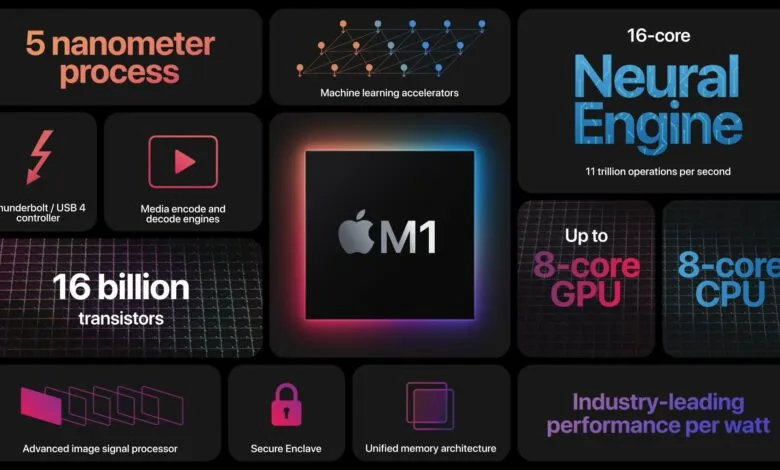
This performance explosion is rooted in significant architectural and manufacturing improvements. The M1 was fabricated using TSMC’s 5-nanometer process, while the M5 benefits from the advanced third-generation 3nm node. The core configuration has expanded from an 8-core CPU and 8-core GPU to a more powerful 10-core arrangement for both. Clock speeds have also seen a substantial bump, rising from 3.2 GHz to 4.61 GHz.
Perhaps the most dramatic enhancements are found in the specialized hardware. The M5 incorporates an integrated Neural Accelerator within every GPU core, a feature absent in the M1. It also includes a third-generation ray tracing engine for realistic lighting in games and professional applications, alongside second-generation dynamic caching for more efficient memory usage. Unified memory support has doubled to 32GB, and memory bandwidth has more than doubled to 153 GB/s, ensuring data flows to the processor cores without bottlenecks.
Apple’s transition away from Intel was methodical. For three years, the company sold Macs with both Apple silicon and Intel processors, providing a bridge for developers and users. The final Intel-based Mac, the 2019 Mac Pro, was officially discontinued in June 2023, marking the end of an era. The software ecosystem has followed suit, with future macOS updates, starting with macOS Tahoe, no longer supporting Intel Macs.
The innovation shows no signs of slowing. Industry reports indicate that Apple’s manufacturing partner, TSMC, is already developing 2nm chip technology. These next-generation processors could debut as early as 2026, promising a 10 to 15 percent speed improvement coupled with a 25 to 30 percent reduction in power consumption. Looking further ahead, 1.4nm chips are on the horizon for 2028, paving the way for even greater performance and efficiency in the years to come.
(Source: Mac Rumors)