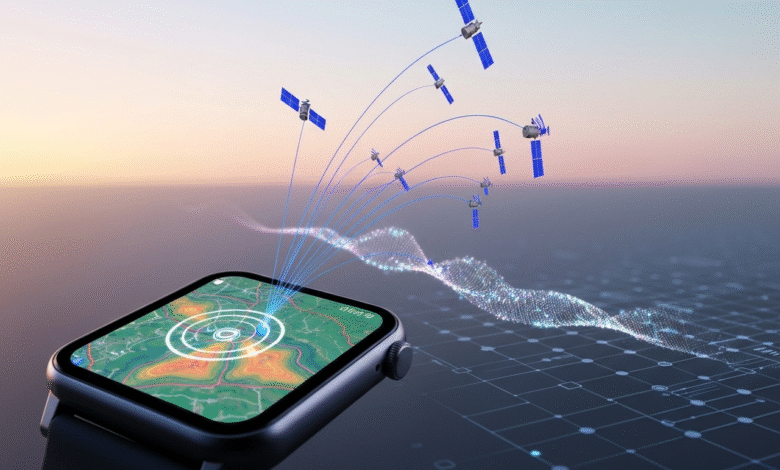
Your Smart Watch Now Pinpoints Your Location to the Centimeter
▼ Summary
– Researchers have developed algorithms enabling smartwatches to achieve centimeter-level positioning accuracy using carrier-phase signals from multiple satellite systems.
– This breakthrough was achieved through collaboration between the University of Otago, Google’s Android Context Group, and the Chinese Academy of Sciences using the Google GnssLogger app.
– Traditional high-precision positioning required expensive specialized antennas and receivers, making it inaccessible despite known benefits of carrier-phase signals.
– Smartwatches previously couldn’t track carrier-phase signals due to hardware and power limitations, but recent advances now make this possible.
– The research demonstrates repeatable centimeter-level positioning (approximately 8 cm accuracy) on smartwatches, opening new possibilities for wearable high-precision technology.
A breakthrough in wearable technology now allows smartwatches to determine your location with centimeter-level precision, a significant leap from the standard meter-range accuracy. Researchers from the University of Otago, working alongside Google’s Android Context Group and the Chinese Academy of Sciences, have created new algorithms that make this possible. They utilized the freely available Google GnssLogger app on Android devices, merging high-quality data from multiple global navigation satellite systems to achieve unprecedented detail in positioning.
The project’s lead, Associate Professor Robert Odolinski of Otago’s School of Surveying, who is also a visiting researcher at Google, explained that this feat was accomplished by harnessing carrier-phase signals. Although experts have long understood that carrier-phase signals could dramatically improve positioning, the specialized antennas and receivers required were historically too expensive for widespread use. Now, everyday gadgets like smartwatches can access this advanced capability.
Standard location tracking on consumer devices depends on measuring how long it takes for signals from various satellites to arrive. By calculating these times and knowing each satellite’s position, along with the speed of radio waves, the device estimates your location within several meters. However, the radio signal itself oscillates in a sine wave pattern many times per second. For GNSS and GPS satellites, this frequency is around 1500 MHz.
By analyzing the phase, or amplitude, of the incoming signal against a local reference, a receiver can identify tiny fractional phase differences. These minuscule shifts correspond to incredibly small changes in distance, each full cycle of a GPS signal wavelength equals roughly 19 centimeters. Until recently, smartwatch hardware and power constraints made it impractical to track carrier-phase signals with the consistency needed for high-precision results. Recent technological progress, however, has removed those barriers.
Odolinski remarked, “This is just the beginning of what wearable high-precision positioning can potentially achieve.”
(Source: ITWire Australia)