Chat Control: Is Your Privacy at Risk?
▼ Summary
– The EU’s proposed Chat Control regulation aims to combat child sexual abuse by requiring digital platforms to detect and remove illegal content.
– Cybersecurity experts warn that mandated scanning undermines end-to-end encryption, creates security vulnerabilities, and erodes user privacy.
– The regulation would impose significant compliance burdens on service providers and make consumer data more vulnerable to exploitation by criminals.
– Implementing Chat Control would disadvantage smaller European tech firms and open-source developers, undermining EU digital sovereignty and innovation.
– Effective child protection requires targeted measures like disrupting distribution networks and prevention efforts, not mass surveillance of private communications.
The European Union’s proposed Chat Control legislation, formally known as the CSAM Regulation, aims to tackle the serious issue of child sexual abuse material by compelling digital platforms to identify, report, and eliminate illegal content, including predatory grooming activities. While the objective of protecting children is universally supported, cybersecurity specialists caution that the proposed methods could critically weaken digital security and personal privacy.
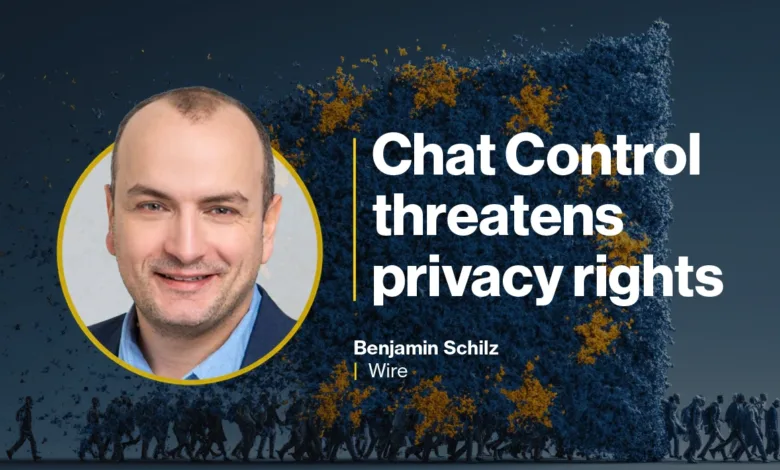
Benjamin Schilz, CEO of the secure communications platform Wire, highlights a fundamental conflict. He explains that legally required scanning systems are completely incompatible with end-to-end encryption. This incompatibility introduces significant liability and compliance hurdles for the companies providing these services.
When asked what technical protections could realistically lessen the potential for abuse if such mandated scanning were implemented, Schilz offers a stark assessment. He believes there are no viable safeguards. The proposal, in his view, is tantamount to installing a universal backdoor into every secure communications system. Once such a vulnerability is created, it will inevitably be discovered and exploited by malicious actors. The core principle of end-to-end encryption and forced scanning are mutually exclusive concepts; a system cannot be simultaneously secure and under constant surveillance.
He uses a powerful analogy, comparing the measure to a law forcing every citizen to leave a key under their doormat for authorities. While framed as a protective measure, this approach actually invites intrusion and fundamentally violates the very security it purports to provide. The regulation threatens to dismantle the encryption protections relied upon by millions of private citizens and businesses, all for a monitoring scheme that the EU’s own data protection advisors have labeled unworkable.
The question of liability for false positives and wrongful accusations is a major concern. Schilz argues that if governments impose scanning mandates, they must also accept legal responsibility for the resulting harms. False positives are not rare mistakes but a statistical certainty. Expert panels, including those within the German Bundestag, have warned that detection systems for new material and grooming conversations are notoriously unreliable and would flood law enforcement with incorrect reports. It is unjustifiable to place the burden of liability on service providers who are being forced to implement a system that technical experts agree is destined to fail.
For security leaders within technology companies, Chat Control would introduce substantial new compliance burdens and reshape their threat models. The primary compliance challenges would involve managing a flood of government access requests, adapting data retention policies, and meeting new audit obligations. From a security perspective, the mandated monitoring infrastructure itself would become a high-value target for exploitation by nation-states and sophisticated criminal syndicates. This would leave consumer and small business data more exposed than ever, likely to be mined and used to orchestrate attacks against other entities, thereby raising the overall threat level.
The regulation also poses a severe threat to Europe’s digital sovereignty. Large American technology conglomerates have the financial capacity to absorb the immense costs of compliance. In contrast, smaller European startups and open-source developers do not. The infrastructure required for scanning, human review, and law enforcement coordination demands resources that only the largest incumbent players possess. The likely outcome would be to lock European innovators out of the secure communications market, increasing the continent’s dependency on foreign cloud providers and directly undermining the EU’s stated goal of technological independence. In essence, Chat Control could render EU tech companies less competitive on a global scale.
This creates a significant barrier to entry, effectively stifling European innovation in secure messaging. Schilz clarifies that Chat Control is not a “targeted” measure but constitutes mass surveillance on a technically unfeasible basis. True targeted intervention is based on specific, justified legal suspicion, a standard this proposal fails to meet.
Is there a credible alternative that balances proportionality with operational effectiveness? The most successful strategies for protecting children online are upstream and focused. These include disrupting distribution networks for illegal material, enhancing international law enforcement cooperation, and investing in robust prevention and educational programs. Mass inspection of private messages is not the solution.
Europe has been a global leader in establishing digital rights and data protection standards. If it now mandates the bulk scanning of private communications, it risks eroding the very trust and security that form the foundation of its leadership. Protecting children is a moral imperative, but it must not come at the cost of fundamental privacy rights for all.
(Source: HelpNet Security)