GPT-4o Returns as Default for ChatGPT Pro Users, Altman Vows Transparency

▼ Summary
– OpenAI has reinstated GPT-4o as a default option for all paying ChatGPT subscribers, removing the need to toggle a legacy models setting.
– Paying users also gain access to older models like GPT-4.1, o3, and o4-mini via a new “Show additional models” setting enabled by default.
– GPT-5 now offers mode selection (“Auto,” “Fast,” or “Thinking”), with “Thinking” mode limited to 3,000 messages/week before switching to a lighter variant.
– GPT-5’s launch faced challenges, including performance inconsistencies and user backlash over the removal of older models, prompting these updates.
– OpenAI plans a “warmer” personality tweak for GPT-5 and is exploring per-user customization to address emotional attachments to specific models.
OpenAI has reinstated GPT-4o as the default model for ChatGPT Pro and other paid subscribers, addressing user feedback after the rocky rollout of GPT-5. The change eliminates the need to manually enable legacy models, giving paying customers immediate access to the previous flagship AI. Subscribers across ChatGPT Plus, Pro, Team, Enterprise, and Edu tiers will now find GPT-4o readily available alongside newer options.
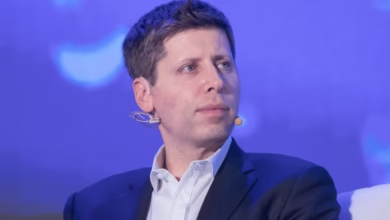
A new “Show additional models” setting also unlocks GPT-4.1, o3, and o4-mini, smaller models optimized for reasoning tasks. CEO Sam Altman confirmed the update on social media, promising transparency if GPT-4o is ever phased out again. “We’ll give plenty of notice,” he wrote, acknowledging the strong preferences some users have for specific AI versions.
The announcement came with additional tweaks to ChatGPT’s interface. Users can now select between “Auto,” “Fast,” and “Thinking” modes when using GPT-5, offering more control over response speed and depth. The “Thinking” mode, designed for complex tasks, currently allows 3,000 messages per week before switching to a lighter variant. Altman hinted these limits may adjust based on demand.
The reversal follows widespread criticism of GPT-5’s launch, which saw technical glitches and performance inconsistencies compared to GPT-4o. Many users expressed frustration when older models were abruptly removed, leading to backlash. By restoring access, OpenAI aims to balance innovation with stability while catering to diverse workflows.
Notably, GPT-4.5 remains exclusive to Pro subscribers due to its high computational costs. Altman also teased an upcoming personality adjustment for GPT-5, aiming for a “warmer” tone without replicating the divisive style of GPT-4o. Longer-term, OpenAI is considering per-user customization, which could help mitigate emotional attachments to specific AI behaviors.
For now, the updates provide a compromise, offering flexibility while maintaining forward momentum. The move underscores the challenges of evolving AI systems without alienating loyal users who rely on familiar tools. As the platform adapts, OpenAI continues refining its approach to model transitions, ensuring smoother experiences in future updates.
(Source: VentureBeat)