European Firm Targets Space Station After Test Flight Success
▼ Summary
– Hélène Huby’s spacecraft crashed due to parachute failure, marking both a success (costing under $25M and reaching space in <3 years) and a failure.
– European space agencies praised the mission as a worthwhile investment despite the partial failure, deviating from traditional intolerance for setbacks.
– The parachute malfunction was likely due to the deployment mechanism, not the parachute provider, but no drop tests were conducted to save time and money.
– Huby admitted underestimating risks and acknowledged the need for more ground testing in hindsight.
– The company must decide whether to build another test spacecraft, though its parachute system differs from the larger Nyx spacecraft, limiting transferable success.
A European aerospace startup has demonstrated remarkable progress despite a recent test flight anomaly, positioning itself as a contender in the competitive space station resupply market. Last month, The Exploration Company experienced a partial failure during its “Mission Possible” spacecraft descent, yet the mission revealed significant achievements in cost efficiency and technical milestones.
Founder Hélène Huby described the outcome as both disappointing and encouraging. The vehicle, developed for under $25 million within three years, successfully completed multiple spaceflight objectives before encountering issues during re-entry. At 26 kilometers altitude, communication was lost as the craft decelerated to Mach one, leading to an uncontrolled splashdown. Surprisingly, European space agencies praised the effort, recognizing that accomplishing 80% of the mission objectives represented a strong return on investment.
An internal investigation pinpointed the likely cause, a malfunction in the parachute deployment system. While the parachutes themselves, supplied by U.S.-based Airborne Systems, performed as expected, the release mechanism developed by The Exploration Company failed. Huby acknowledged that skipping drop tests to save time and money was a miscalculation. Ground testing could have identified the flaw earlier, but the company prioritized speed and lean operations.
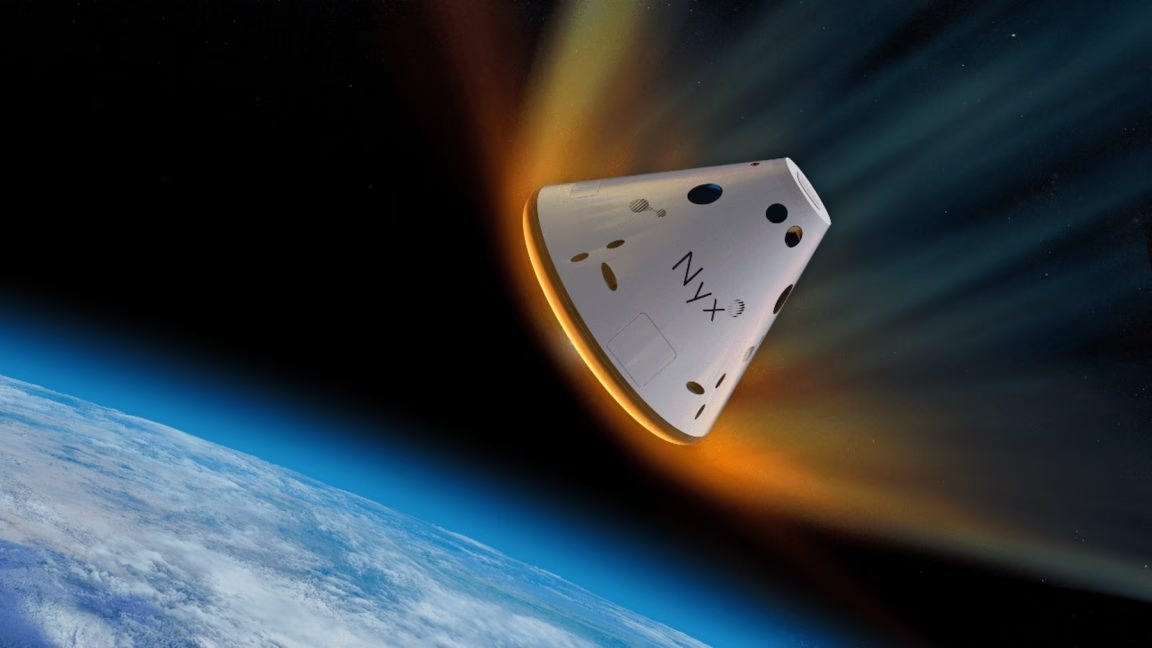
Now, the team faces a critical choice: whether to build another test vehicle or shift focus entirely to their operational spacecraft, Nyx. Since the parachute systems differ significantly between the two models, perfecting the smaller Mission Possible design wouldn’t guarantee success for Nyx. This decision will shape the company’s trajectory as it aims to secure contracts for International Space Station logistics.
Despite the setback, the mission proved that agile, budget-conscious spaceflight is achievable. European support suggests a growing appetite for risk-taking in the region’s space sector, potentially opening doors for faster innovation. The Exploration Company’s next steps will determine whether it can turn lessons from failure into long-term success.
(Source: Ars Technica)