▼ Summary
– Some people blamed cloud seeding by startup Rainmaker for Texas floods, but experts confirm it had no role in the disaster.
– Cloud seeding, used since the 1950s, involves spraying silver iodide to encourage ice crystal formation and precipitation in suitable clouds.
– Most U.S. cloud seeding occurs in winter near Western mountains to enhance snowpack, not in summer storms like Texas’.
– Recent studies show cloud seeding can add modest precipitation (e.g., 186M gallons), but this is negligible compared to major storms’ trillions of gallons.
– Texas’ storm clouds were short-lived and naturally efficient, making seeding ineffective, and Rainmaker’s operations days prior had no impact.
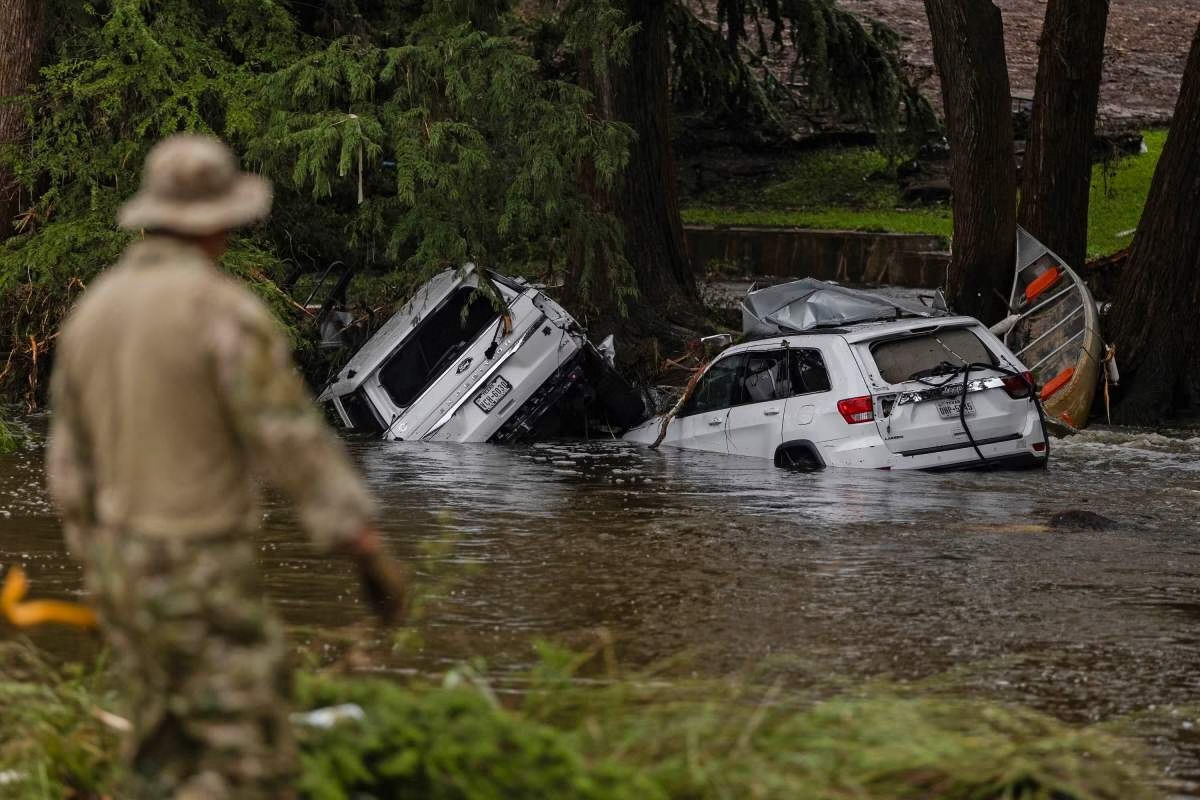
When natural disasters strike, speculation often follows, and the recent catastrophic floods in Texas have been no exception. Among the theories circulating online, some have pointed fingers at cloud seeding, specifically blaming a startup called Rainmaker for allegedly intensifying rainfall. Yet experts confirm these claims hold no scientific merit.
Atmospheric scientists have dismissed the idea outright. “Cloud seeding had nothing to do with the flooding,” stated Katja Friedrich, a researcher at the University of Colorado Boulder. Bob Rauber, a professor at the University of Illinois, echoed this, calling the accusations “a complete conspiracy theory” driven by the human tendency to assign blame during crises.
Cloud seeding isn’t a new or mysterious practice. Used since the 1950s, it involves dispersing particles, typically silver iodide, into clouds to encourage precipitation. These particles mimic ice crystals, prompting supercooled water droplets to freeze and grow into snowflakes or raindrops. However, the technique only works under specific conditions, requiring clouds with ample supercooled water.
In the U.S., most cloud seeding happens in winter near Western mountain ranges, where orographic clouds form as air rises and cools. When seeded, these clouds release snow that later melts into reservoirs, aiding water supply and hydroelectric power generation. Recent studies, like one conducted in Idaho, have quantified its impact, adding roughly 186 million gallons of precipitation over several seeding sessions. While significant for drought relief, this amount pales in comparison to the trillions of gallons processed by major storms like Texas’.
Rainmaker’s operations couldn’t have influenced the floods for several reasons. First, the company seeded clouds days before the storm, meaning the treated air had long since moved elsewhere. Second, Texas’ summer cumulus clouds behave differently from winter orographic clouds, they’re shorter-lived and less responsive to seeding. Even if seeding were attempted, thunderstorms are already highly efficient at producing rain naturally, rendering additional intervention ineffective.
The bottom line? Cloud seeding didn’t cause the Texas floods. While the technology plays a role in water management, its effects are localized and modest, nowhere near capable of triggering catastrophic weather events. The real culprit lies in natural atmospheric processes, not human intervention.
(Source: TechCrunch)