Tesla Delivers Driverless Model Y to Showcase Robotaxi Tech

▼ Summary
– Tesla completed an “autonomous delivery” of a Model Y SUV using self-driving software, driving 15 miles from its factory to a customer’s apartment without human intervention or remote assistance.
– The demonstration coincided with Tesla’s upcoming financial results, which are expected to be poor, but the news temporarily boosted the company’s stock price.
– The Model Y successfully navigated complex driving scenarios, including highway merges and unprotected turns, showcasing advancements in Tesla’s autonomous technology.
– Questions remain about Tesla’s preparation for the drive, given past controversies involving staged demonstrations and pre-mapped routes for similar tests.
– Critics raised minor concerns about the delivery, such as the car stopping in a fire lane, but the stunt lacked major safety criticisms compared to previous tests.
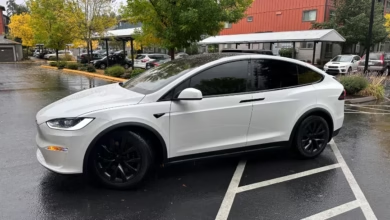
Tesla recently made headlines by delivering a Model Y to a customer without anyone behind the wheel, showcasing its latest advancements in autonomous driving technology. The electric vehicle manufacturer orchestrated a 15-mile journey from its factory in Austin, Texas, to the buyer’s residence, marking what CEO Elon Musk described as the first fully driverless customer delivery. While the car initially ran on the same software powering Tesla’s robotaxi fleet, it was later downgraded to the commercially available Full Self-Driving (Supervised) system, which still requires human oversight.
The timing of this demonstration couldn’t be more strategic. Tesla is gearing up to release its second-quarter financial results, which analysts predict may reflect declining sales, a trend exacerbated by recent controversies surrounding Musk’s political engagements. Despite these challenges, the company’s stock saw a brief surge following Musk’s announcement, though market fluctuations later tempered the gains.
The route taken by the Model Y was far from simple. Navigating highways, roundabouts, and unprotected left turns in broad daylight, the vehicle handled scenarios that would have stumped earlier iterations of self-driving tech. A 30-minute video of the trip, later condensed into a three-minute highlight reel, captured the car’s ability to merge seamlessly into traffic and execute complex maneuvers, a testament to Tesla’s progress in autonomous systems.
However, this achievement raises several unanswered questions. How much preparation went into this demonstration? Past controversies, like Tesla’s 2016 promotional video of a supposedly autonomous drive, cast doubt on whether the company fully disclosed the extent of pre-mapping and trial runs involved. Additionally, while Waymo and Zoox have also demonstrated highway-capable autonomous vehicles, Tesla’s ability to replicate this performance consistently remains unproven.
Critics have been vocal about Tesla’s Full Self-Driving software, but even one of its fiercest detractors, Dan O’Dowd, could only point out that the Model Y parked in a fire lane, a relatively minor flaw compared to previous accusations of safety risks. Still, skepticism lingers, especially given Musk’s unfulfilled 2016 promise of a coast-to-coast autonomous trip.
As Tesla continues testing its robotaxi service in Austin, the bigger question isn’t just whether the technology works, it’s whether the company can scale it reliably. For now, this driverless delivery serves as both a milestone and a reminder of the challenges still ahead.
(Source: TechCrunch)