US Approves Mirror Satellite to Reflect Sunlight at Night
▼ Summary
– The FCC authorized Reflect Orbital to launch its experimental mirror satellite Eärendil-1, which reflects sunlight to Earth at night.
– The satellite aims to power solar panels after dark and support applications like search-and-rescue and emergency lighting.
– Astronomers and environmental groups oppose the project, citing threats to astronomy, nocturnal wildlife, and aviation safety.
– Reflect Orbital plans to eventually operate 50,000 satellites, but the FCC approved only a single test satellite for a limited-duration technology demonstration.
– The FCC decision notes that any future commercial constellation would require separate regulatory approvals.
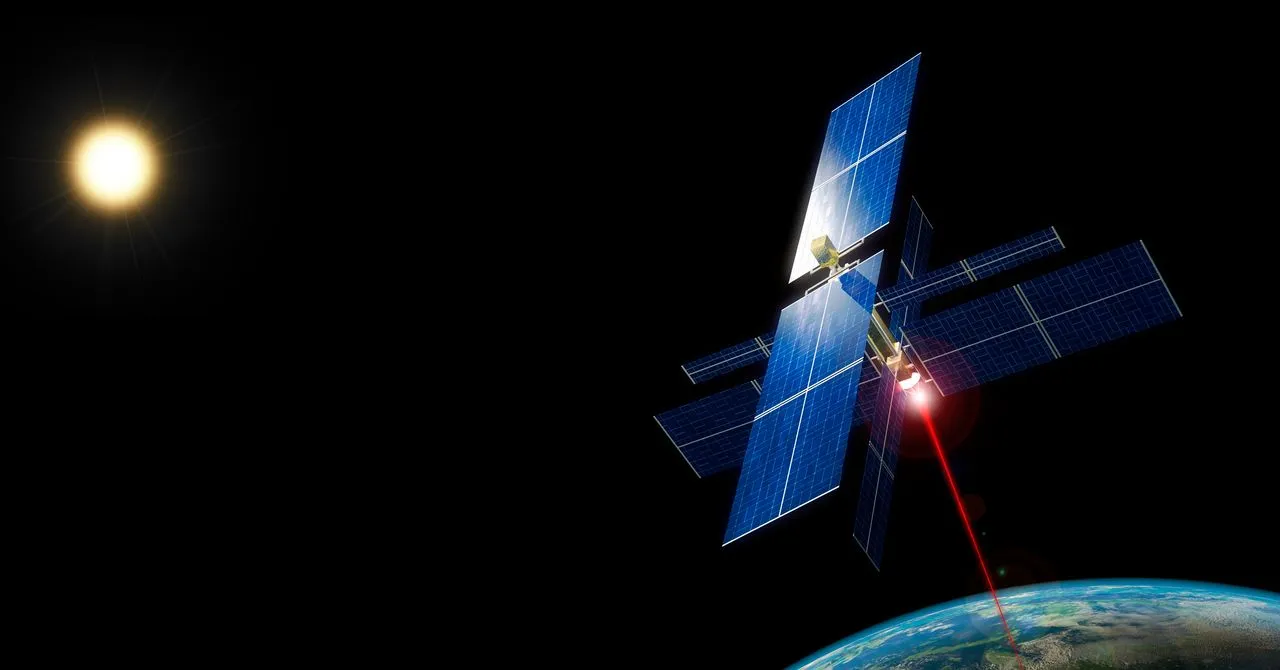
On July 9, the U.S. Federal Communications Commission gave the green light to Reflect Orbital for the construction, launch, and operation of a mirror satellite in low Earth orbit. This experimental spacecraft, designated Eärendil-1, is designed to reflect sunlight onto specific nighttime locations on Earth. The project has long faced strong opposition from astronomers and environmental groups.
WIRED first reported on Reflect Orbital’s ambitious concept in September 2024, when the venture was still taking shape. The Santa Monica, California-based startup aims to provide a continuous light source for large-scale solar installations, enabling them to generate electricity after dark and thereby addressing a key limitation of solar power. Now, two years later, the Trump administration has authorized this provider of on-demand sunlight.
Eärendil-1 will carry an 18-meter reflector capable of illuminating areas between 5 and 6 kilometers in diameter for short periods. The satellite’s name references a character from J. R. R. Tolkien’s Lord of the Rings. Under the authorization, the company can deploy the test satellite at an altitude of roughly 625 kilometers. Its primary mission is to test the technical viability of an ultrathin, highly reflective film-based reflector.
“We’re grateful to the FCC for granting our application to fly our test mission,” the company posted on social media. “This ruling is hugely validating for our company and reflects America’s leadership in testing innovative space technology.”
Reflect Orbital argues that this controversial technology could serve a range of civilian, commercial, and government purposes. Potential applications include illuminating search-and-rescue operations, supporting critical infrastructure during emergencies, extending productive hours for solar farms, and temporarily lighting remote construction sites without relying on traditional generators.
Beyond ‘Let Us Sleep’
Eärendil-1 would be just the first step. Reflect Orbital has plans to operate 50,000 satellites by 2035,and that is only one company. If the initiative succeeds, it could spawn an entirely new global industry, a prospect that is already keeping many people awake, at least figuratively. “Imagine the sky filled with moons,” says Tony Tyson, a researcher at the University of California, Davis and chief scientist for the Vera C. Rubin Observatory. Tyson remains skeptical that these satellites can direct reflected light with the precision the startup claims.
During the regulatory review, the FCC received nearly 2,000 public comments raising concerns about the proposal. Leading critics include the American Astronomical Society, DarkSky International, and the Royal Astronomical Society. These organizations warn of potential impacts on astronomy, nocturnal ecosystems, and aviation safety.
Opponents note that ground-based observatories already struggle with thousands of satellites in low Earth orbit that interfere with observations. Even a small number of space mirrors could worsen light pollution and hinder scientific work, while a full-scale constellation would fundamentally alter the night sky. “For optical astronomy, this is an existential threat, and we hope that the regulators will share that view,” said Betty Kioko, institutional affairs officer for the European Southern Observatory, in a statement before the FCC decision.
Researchers have also flagged risks from reflected flashes that could affect aircraft pilots, drivers, or wildlife dependent on natural light-dark cycles.
Despite these objections, the FCC concluded that the application covers only a single experimental satellite, not a commercial constellation. The agency’s decision states that Eärendil-1 is a limited-duration technology demonstration whose results will help determine technical feasibility and identify challenges for any future developments. Any subsequent deployment of multiple satellites would require new regulatory approvals.
(Source: Wired)