Nadella’s Paradox: The Hidden Cost of AI
▼ Summary
– Microsoft CEO Satya Nadella warns that AI buyers pay twice: once in cash, and again in the proprietary knowledge they feed the model to make it useful.
– He calls this the Reverse Information Paradox, where the AI seller learns more about the buyer through usage while the buyer learns little in return.
– Knowledge leaks through “exhaust” like prompts, agent tools, and user corrections, which train the model imperceptibly over time.
– Nadella acknowledges the irony that Microsoft, which invested in OpenAI and sells Copilot, has contributed to this dynamic and faced customer curbs over data fears.
– His proposed solution is a strict “trust boundary” around company data and evals, with Microsoft offering products to implement this, but the core warning remains that firms are giving away valuable know-how for free.
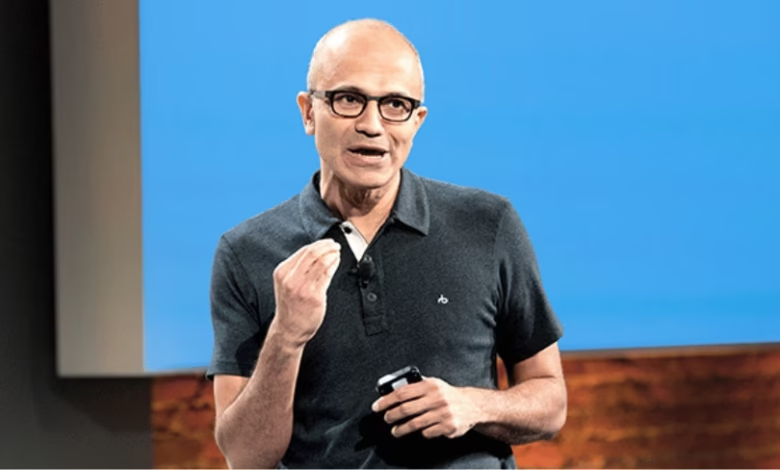
Satya Nadella has a blunt warning for any business buying artificial intelligence. You are paying twice. And the second payment is your company’s most valuable asset.
In a lengthy essay on X that racked up 10 million views, the Microsoft CEO introduced what he calls the Reverse Information Paradox. It is sharp, a little academic, and more than a little awkward coming from the leader of a company that built much of the infrastructure for this very trade.
Pay once in cash, once in secrets
The name plays on the work of Nobel economist Kenneth Arrow. His original paradox described the seller’s dilemma: to sell information, you must reveal it, and once revealed, why would anyone pay?
Nadella flips the logic. In the AI era, he argues, the risk sits with the buyer. To make a model genuinely useful, you must feed it your proprietary knowledge. The better you want it to work, the more you feed it.
So you pay in cash, then again in something worth more: the know-how that makes your company yours. “The seller learns more and more about you as you use what you purchased,” he wrote, “while you learn very little about what the seller is learning in return.”
The leak you cannot see
The clever part is where Nadella explains how the knowledge escapes. Not through some obvious breach, but through what he calls “exhaust”: the prompts you write, the tools your agents use, and above all the corrections you make when the model gets something wrong.
Every fix teaches the model. “It’s the kind of knowledge a competitor could never buy,” Nadella wrote, “and the kind that leaks almost imperceptibly: trace by trace, correction by correction, eval by eval.”
His verdict is blunt. If learning only flows one way, the money flows with it, toward whoever owns the AI, not whoever owns the knowledge.
The irony is doing a lot of work
Here is the catch. This is Microsoft talking.
Redmond poured billions into OpenAI and hosts ChatGPT on Azure. Its Copilot assistant is built to reach deep into a company’s email, files and chat. Back in 2024, roughly half of the data chiefs in one survey had paused or curbed Copilot over exactly this fear, as the Register noted.
To his credit, Nadella names his own side’s double standard. AI labs demand fair-use rights to train on the public web, then restrict customers from doing the same with model outputs. He is not wrong. He is also selling the fix.
Nadella’s answer, and his pitch
The solution, he says, is a hard “trust boundary” around a company’s data, evals and memory. Nothing crosses it, “not even the intelligence exhaust, without consent.” He borrows a line from Palantir’s Alex Karp about wanting to own the means of production.
His checklist runs to five points. Own your evals. Build learning environments inside your own tenant boundary. Keep the orchestration layer free of any single model. Then let it all compound. Microsoft, naturally, sells products that do each of these things.
Strip out the pitch and the core point still holds. This is the same executive who turned on the AI giants he helped build. The frontier labs are quietly amassing a fortune in other companies’ know-how. And the firms handing it over are, for now, doing it for free.
(Source: The Next Web)