VAR at the 2026 World Cup: Human Error, Not Tech, Is the Issue
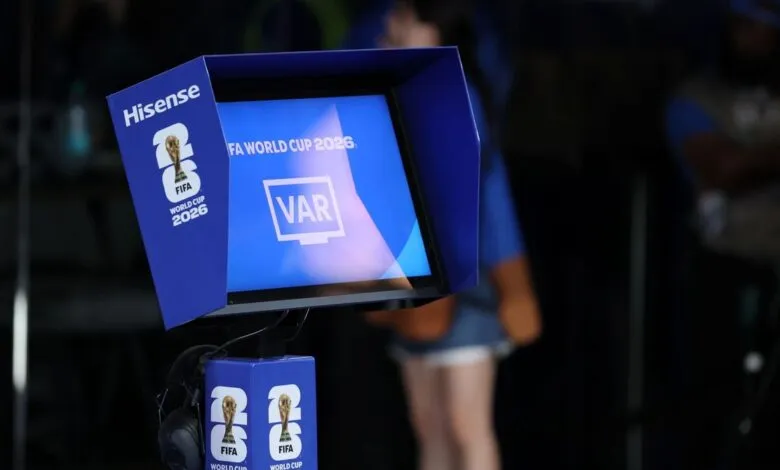
▼ Summary
– A 2026 World Cup match between Argentina and Egypt sparked major VAR controversy after Egypt lost 3-2 despite holding a two-goal lead.
– Egypt’s football association filed a formal protest with FIFA, arguing that improper VAR use influenced refereeing decisions.
– Critics claim VAR has been used inconsistently throughout the World Cup, with some alleging it favors certain teams.
– VAR uses 42 broadcast cameras, including slow-motion and semi-automated offside detection, to assist a team of referees in reviewing goals, penalties, red cards, and mistaken identity.
– For the 2026 World Cup, FIFA expanded VAR’s scope to review second yellow cards and infractions related to the Prestianni-Vinícius Rule.
The Round of 16 clash between Argentina and Egypt at the 2026 World Cup will be remembered for more than just stunning goals and dramatic saves. It has ignited a fierce debate about the video assistant referee (VAR) system, with critics arguing that human error, not the technology itself, is undermining the integrity of the game. Egypt’s 3-2 elimination, after surrendering a two-goal lead, has become a flashpoint.
The Egyptian Football Association has formally protested to FIFA, alleging that “the failure to properly use VAR” skewed several critical decisions. In a pointed social media statement, the association declared it “cannot remain silent regarding the refereeing decisions observed during the match against Argentina.” It called for an investigation into what it sees as inconsistencies, stressing the need for “the highest standards of integrity, fairness, and transparency in refereeing, particularly in a competition of the magnitude and importance of the 2026 FIFA World Cup.” Local and international analysts have echoed these concerns, highlighting specific incidents that altered the match’s trajectory.
This controversy is not isolated. Throughout the tournament, complaints have mounted over goals disallowed for offside calls that were never signaled on the field, fueling a perception that VAR is being used to favor certain teams. Some detractors argue the system disrupts the game’s flow and can be manipulated to adjust rulings. Others question whether the technology itself is flawed or if the problem lies in its application.
These tensions raise fundamental questions: Can VAR alone guarantee fairness? Are the controversies rooted in the system’s limitations or its misuse? And are all match officials at the 2026 World Cup adequately trained to operate this assistive tool?
Introduced at the 2018 World Cup in Russia, VAR was designed as a support mechanism for on-field referees. It has since been adopted in over 100 competitions worldwide, including the 2022 tournament in Qatar. The system relies on 42 broadcast cameras, eight of which capture super-slow-motion footage and four of which provide ultra-slow-motion angles. It also integrates feeds from semi-automated offside detection cameras and the FIFA host network.
A dedicated team of a video assistant referee and three assistants reviews these angles for specific interventions: goals and infringements leading to them, penalty decisions, direct red cards, and cases of mistaken identity. For the 2026 edition, FIFA expanded VAR’s purview. The system can now correct clearly erroneous second yellow cards to prevent unjust send-offs. It also helps detect blocking, shoving, offsides, or offensive fouls before free kicks and corner kicks.
Armando Archundia, a former Mexican World Cup referee, told WIRED en Español that new features also target infractions related to the Prestianni-Vinícius Rule, which mandates a direct red card for players covering their mouth with a hand, arm, or jersey during a confrontation. Additionally, VAR now helps distinguish between corner kicks and goal kicks, reducing confusion. Yet, as the Egypt-Argentina match demonstrates, even with expanded capabilities, the human element remains the most volatile variable.
(Source: Wired)