Dragonflies Maneuver Like Fighter Pilots, Study Shows
▼ Summary
– A new study shows male dragonflies use simple rules to maintain tactical positions during mid-air “dogfights,” mirroring human fighter pilot tactics.
– The research on dragonfly flight behavior could lead to smarter drones that navigate with simple, vision-based guidance instead of complex computation.
– Male dragonfly interactions involve mutual pursuit, unlike asymmetric chases seen in predation or mating, and the study focused on the fiercely territorial Trithemis Aurora species.
– Researchers used a stereovideographic rig with two synchronized cameras to reconstruct 102 male flight trajectories and nine prey interception trajectories in 3D.
– Analysis confirmed dogfighting dragonflies displayed more convoluted trajectories and were viewed against foliage or ground, while hunting dragonflies approached prey from below against the sky.
Male dragonflies are masters of aerial combat, engaging in mid-air “dogfights” to protect their breeding grounds. A recent study published in the Journal of the Royal Society Interface reveals that these insects follow surprisingly simple rules during these confrontations, primarily focusing on maintaining a tactical position over their rivals. This behavior closely mirrors the strategies used by human fighter pilots, and the findings could inspire smarter drone navigation systems that rely on basic visual cues rather than heavy computational power.
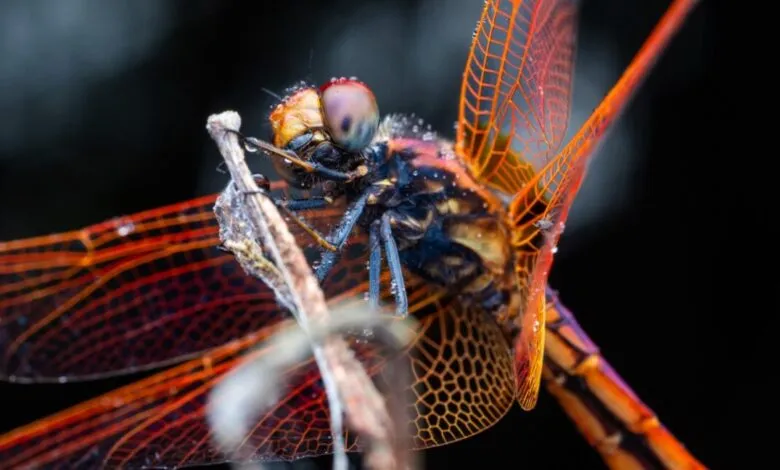
In typical predator-prey or mating pursuits, the roles are clear: one chases, the other evades, each requiring distinct maneuvers. But when male dragonflies face off, it becomes a mutual pursuit, with both participants actively adjusting their flight paths. The researchers studied the Trithemis Aurora species, known for their fiercely territorial nature. These crimson-colored dragonflies are easy to track and often gather around ponds, each male intent on defending its chosen perch.
Previous studies on dragonfly interactions depended on visual observations or single-camera recordings. For this research, the team deployed a portable stereovideographic rig with two shutter-synchronized cameras, capturing both color and monochrome footage. They reconstructed 102 paired male-on-male flight trajectories in 3D, along with nine trajectories of dragonflies intercepting prey for comparison. This data allowed them to model the underlying rules of their flight behavior.
The analysis confirmed stark differences between hunting and territorial defense. When hunting, dragonflies approach prey from below, often viewing it against the bright sky. In contrast, dogfighting males follow highly convoluted paths and are more likely to be seen against complex backgrounds like foliage or the ground. These insights not only deepen our understanding of insect behavior but also point toward vision-based guidance systems for drones that could navigate with remarkable precision using minimal processing.
(Source: Ars Technica)