Artificial Cell Achieves Multiple Rounds of Division
▼ Summary
– Understanding life’s origin involves explaining how simple chemicals formed complex molecules, but a key puzzle is how membranes first enclosed cells.
– Membranes form easily and trap dissolved materials, but they then isolate the interior, halting chemical reactions by cutting off new supplies.
– University of Minnesota researchers created a simplified system where membranes enclose genetic material and can continuously import new materials, and it spontaneously divides.
– The system, called SpudCells, is still heavily dependent on human intervention but may help explore the minimal requirements for life.
– The SpudCell uses DNA replication machinery from the Phi29 virus, with its genetic material spread across seven circular DNA molecules totaling about 90,000 bases.
Understanding how life first emerged means tackling a series of intertwined scientific puzzles. Researchers have made significant strides in explaining how simple chemicals on primordial Earth assembled into the complex molecules necessary for life, and how some of those chemicals formed early genetic and catalytic systems. But a major gap remains: How did membranes first form around the earliest cells?
Membranes can form spontaneously in water, and they will readily encapsulate any dissolved material, including nucleic acids. However, once formed, these membranes seal off their contents from the surrounding environment. Any chemical reactions happening inside would quickly consume available resources and come to a stop.
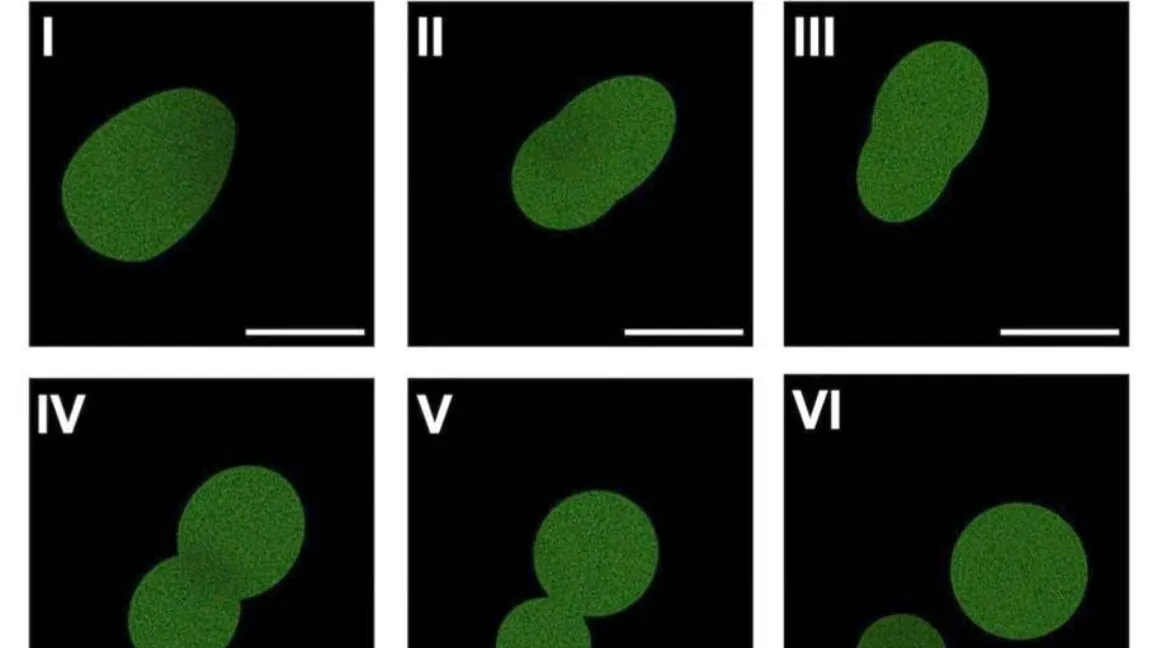
Now, a team at the University of Minnesota has announced the development of a simplified system where a membrane encloses genetic material while remaining capable of continuously importing fresh supplies from the outside. The system also undergoes spontaneous division, producing several generations of “offspring” before eventually failing. Though it still requires significant human intervention, this breakthrough could open new pathways for exploring the origin of life and what a truly minimal form of life might look like.
The Genetics of SpudCells
The research, led by Kate Adamala, has not yet been peer-reviewed (a draft manuscript is available online). The team essentially assembled components from various biological systems described by other researchers and wrapped them inside a membrane. Many of these components originated in viruses, which are known for their stripped-down versions of cellular machinery.
For instance, the system used to copy the DNA inside what Adamala calls a “SpudCell” comes from a virus that infects bacteria, known as Phi29. Earlier work by another group had shown that DNA encoding the viral proteins needed for replication could be placed inside a membrane, where it would successfully copy itself. The Minnesota team adapted this approach for their own system, which distributes roughly 90,000 base pairs of DNA across seven separate circular DNA molecules.
(Source: Ars Technica)