Study: Bumblebees Spontaneously Solve Problems
▼ Summary
– Bumblebees can spontaneously solve object-manipulation tasks without prior training, a cognitive ability previously unseen in insects, according to a new paper in Science.
– In 2024, a study co-authored by Olli Loukola showed bumblebees can cooperate to solve complex challenges, a task previously only observed in large-brained mammals.
– Trained pairs of bees pushed a Lego block or a door to get a reward, and were more likely to engage if their partner participated.
– Researchers concluded bees can learn novel cooperative tasks outside the hive and may intentionally work together, though more monitoring is needed.
– In the latest experiment, bees rolled a ball into a pit to climb onto it and reach an artificial flower, solving an insect version of the “box-and-banana” problem.
Despite possessing brains no larger than a poppy seed, bumblebees continue to astonish researchers with their cognitive flexibility. A new study published in Science reveals that these insects can spontaneously solve object-manipulation puzzles without any prior instruction. According to the research team, this marks the first documented instance of untrained problem-solving in an insect species.
In 2024, Olli Loukola from the University of Finland co-authored a paper showing that bumblebees could collaborate to overcome complex obstacles, a skill previously attributed only to large-brained mammals such as humans and chimpanzees. In that experiment, Loukola and colleagues trained pairs of bees to either push a Lego block to the center of a small arena or press against a door at the end of a tunnel to access a reward.
The researchers observed that bees were far more likely to engage in these tasks when their partner also participated, compared to untrained control groups. Their conclusion: bees can learn to solve novel cooperative problems outside the hive and may even coordinate intentionally. Still, the team cautioned that more detailed behavioral monitoring was necessary to fully parse each partner’s role.
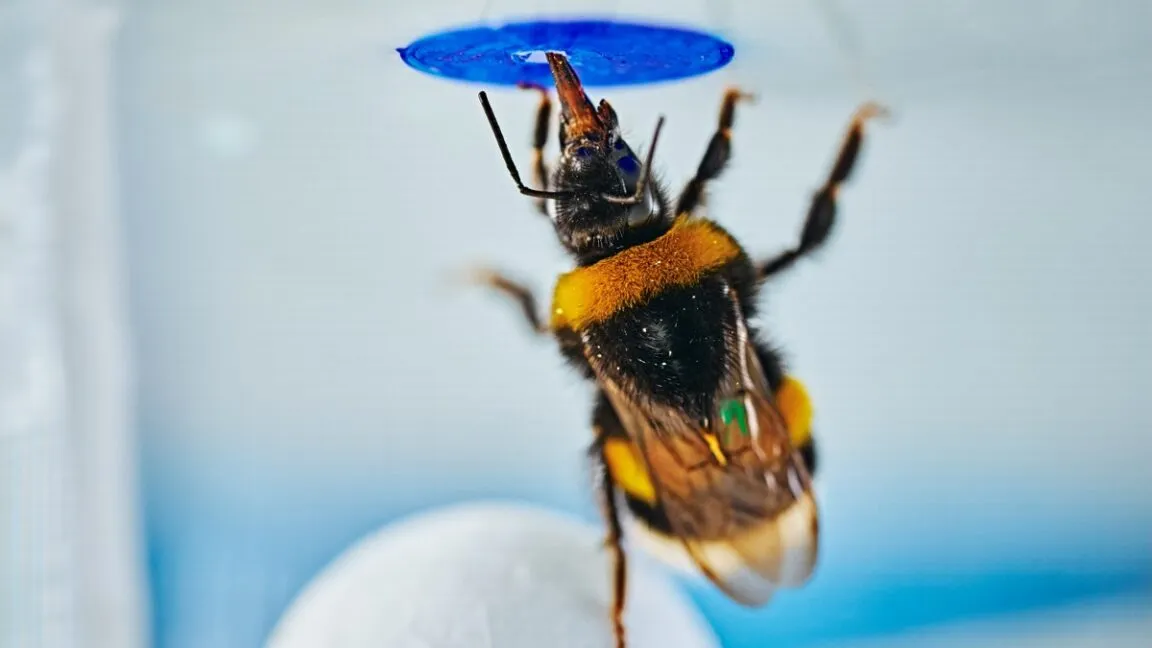
For the latest study, Loukola shifted focus to whether bees could solve problems on their own, without any training. The first experiment placed an artificial flower above a pit in the floor, leaving no room for a bee to hover and reach the flower directly. To succeed, the bee had to roll a small ball into the pit and climb on top to reach the flower. “This is essentially an insect version of the classic ‘box-and-banana’ problem,” Loukola explained. “The animal must realize that an object can be repositioned and then used as a tool to reach an otherwise inaccessible goal.”
(Source: Ars Technica)