Ugly Ads Outperform Polished Creative: How to Test

▼ Summary
– Traditional advertising rules promote polished, scripted content, but many top-performing ads now intentionally use scrappy, unpolished formats to stand out.
– Platform-recommended best practices are designed for a frictionless user experience, but this can make ads predictable and easy for users to ignore.
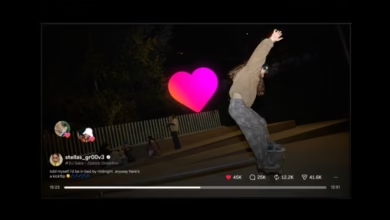
– Unpolished ads, like grainy footage or notes app screenshots, can bypass viewers’ ad defenses by looking more authentic and less like traditional advertising.
– Founder-led or authentic human content performs well, but only if it feels genuine, as staged attempts can be quickly identified and rejected by audiences.
– A strategic approach to breaking rules involves testing unconventional formats with a small portion of your budget while maintaining a baseline of reliable content.
For years, the marketing playbook has been clear: use high-quality visuals, maintain a polished brand image, and adhere strictly to platform guidelines. Yet a powerful counter-trend is emerging, where unpolished creative and so-called ugly ads are consistently outperforming their glossy counterparts. This shift isn’t about abandoning quality, it’s about strategically breaking established rules to capture attention in an oversaturated digital landscape.
The conventional best practices promoted by platforms serve a specific purpose. They are designed to create a seamless, low-friction experience that keeps users engaged. The unintended consequence is that ads which follow these rules too closely become predictable. They signal “advertisement” immediately, training users to scroll past them without a second thought. In contrast, content that feels authentic and native, like a grainy video from a phone or a casual founder-led ad, disarms this instinct. It keeps the viewer’s defenses down just long enough for your message to land.
This approach hinges on authenticity. A forced or staged attempt at being “real” will be spotted instantly by audiences. Consider the recent contrast between two fast-food campaigns. One featured a CEO in a stiff, corporate presentation that felt like a product demo. The other showed a company president taking a genuine, enthusiastic bite in a real kitchen setting. The latter resonated because it felt like a human moment, not a marketing script. If your team doesn’t look genuinely excited, customers won’t be either.
Effective rule-breaking also involves understanding user psychology. Instead of opening with a product shot, try starting with a screenshot of a negative comment or a common pain point. This taps into the natural curiosity that draws people into a digital conversation. By the time the viewer realizes it’s promotional content, you’ve already communicated your key value proposition. This method leverages conflict and native platform aesthetics, like comment bubbles, to interrupt scrolling patterns and secure precious seconds of attention.
Adopting this strategy requires a safety net. You shouldn’t shift your entire budget overnight. A prudent method is the 80/20 rule, where 80% of your spend maintains a proven baseline of performance, while 20% is allocated for testing unconventional formats. This allows for innovation without reckless risk.
Consider these tactical tests for your next campaign. Run a silent ad with bold captions to stand out in a feed saturated with audio. Design a static image that mimics a platform notification, like a low-battery warning, to hijack visual patterns in the scroll. Or, conduct an algorithmic trust fall by turning off some manual optimizations and using broad targeting, allowing your compelling creative to naturally find its audience.
Ultimately, best practices are a useful starting point, not a definitive strategy. The goal is to move from blindly following rules to deeply understanding their intent. Systematically test opposites: polished versus lo-fi, scripted versus unscripted, corporate voice versus personal tone. In a crowded feed where most brands play it safe, the advantage goes to those who learn the rules thoroughly, then learn how to break them with purpose. The winners will be those who focus on understanding audience behavior faster than the competition.
(Source: Search Engine Land)