Oppo’s New Phone Camera Array May Be Excessive
▼ Summary
– The Oppo Find X9 Ultra is unique for reintroducing a 10x telephoto lens, a feature not seen in new phones for three years.
– The phone’s 10x lens is its best yet but struggles with moving subjects and low light compared to its other excellent cameras.
– It launches in Europe and the UK with top-tier specs, including a powerful processor, large battery, and a high refresh rate display.
– The design is explicitly styled after retro cameras, with a vegan leather back and horizontal logos emphasizing its camera-first identity.
– The device requires users to agree to seven mandatory agreements and over eight optional ones to use it.
In the competitive arena of flagship smartphones, the Oppo Find X9 Ultra makes a bold statement by resurrecting a feature absent from the market for three years: a dedicated 10x telephoto lens. This move, reminiscent of Samsung’s past strategy, aims to secure a decisive victory in mobile photography. While the lens itself represents a technical achievement, its practical utility in everyday scenarios raises questions about whether such extreme optical reach is truly necessary or merely an elaborate spec sheet highlight.
Beyond its headline camera, the Find X9 Ultra establishes itself as a premium flagship in every other regard. It launches in Europe and the UK this May, priced at £1,449, and delivers a compelling package of top-tier specifications. The device is powered by the Qualcomm Snapdragon 8 Elite Gen 5 processor and features a robust 7,050mAh silicon-carbon battery that easily lasts a full day. Its 144Hz OLED display is protected by Gorilla Glass Victus 2, and it carries comprehensive IP ratings for dust and water resistance. Support for five major Android OS updates and six years of security patches future-proofs the investment. While 100W charging requires Oppo’s proprietary tech, it still supports 55W USB-PD charging for broader compatibility.
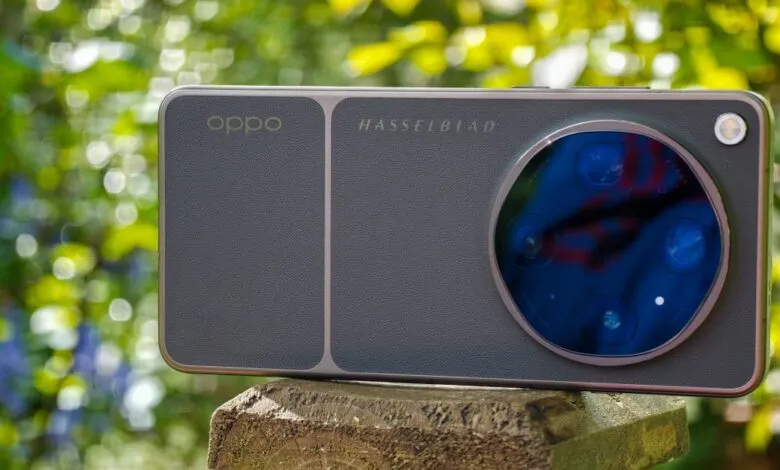
Where Oppo truly differentiates the X9 Ultra is through its retro-inspired design. The review unit’s “tundra umber” finish, with its two-panel vegan leather rear, consciously evokes classic camera aesthetics. Horizontal branding from Oppo and Hasselblad emphasizes the device’s landscape-oriented photography intent. Thoughtful design touches include comfortable flat edges with curved corners and subtle Hasselblad orange accents on the shutter button and camera ring. The overall execution feels more cohesive than attempts from rivals, with only the hexagonal detailing on the camera glass feeling somewhat out of place.
The camera system is undeniably comprehensive. Alongside a 50MP front-facing camera, the rear array includes four lenses: a 200-megapixel main sensor, a 50-megapixel ultrawide, a 3x telephoto, and the standout 230mm equivalent 10x periscope telephoto. Video capabilities are impressive, with all lenses supporting 4K 60fps Dolby Vision HDR recording. The Hasselblad Master mode provides professional controls, the ability to shoot RAW across all lenses, and a selection of film simulations that offer a more natural, less processed look compared to the standard mode.
Performance from the primary and 3x telephoto cameras is exceptional. Both utilize larger sensors and faster apertures than many competitors, resulting in photos with superb detail, wide dynamic range, and excellent low-light performance. The main camera, in particular, is predictably outstanding.
The 10x telephoto lens, however, occupies a more niche position. Oppo has engineered it with a larger sensor and a faster aperture than its predecessor from Samsung, claiming a significant gain in light capture. In ideal conditions, with a static, well-lit subject, it can produce crisp, colorful images. Yet, it remains the only lens in the array to show significant limitations. It struggles with moving subjects, exhibits inconsistent color science compared to the other cameras, and can blow out highlights. In many situations, the camera app will automatically default to using the 3x lens with digital zoom instead, questioning the dedicated hardware’s constant necessity.
The fundamental issue is one of reliable utility. While a 70mm equivalent lens has become a frequently used tool, the extreme reach of a 230mm lens caters to specific moments, like distant sports or concerts. Unfortunately, these are precisely the scenarios involving challenging lighting and motion where this lens falters. Compared to Oppo’s own add-on telephoto extender lenses, which are bulkier but offer superior optical performance for dedicated shooters, the integrated 10x feels like a compromise. One is left to wonder what trade-offs were made to include it, whether in the form of larger sensors for other cameras, a bigger battery, or a lower price point.
The Oppo Find X9 Ultra is an excellent smartphone with a standout design and a mostly phenomenal camera system. Its attempt to integrate a long-range optical zoom is a notable engineering feat. Yet, the lens’s situational limitations make it feel more like a technical showcase than an indispensable everyday tool, suggesting that a version of this phone without it might have been an even more compelling product.
(Source: The Verge)