Samsung SmartThings Update Adds Elderly Care Monitoring
▼ Summary
– Samsung’s SmartThings update introduces family care features that use connected appliances and wearables to remotely monitor elderly relatives for safety and health.
– Key capabilities include fall detection via a robot vacuum’s camera, environmental safety alerts, activity tracking, and screening for cognitive decline through behavioral pattern analysis.
– The system uses ambient sensing with millimeter-wave radar and local data processing in the SmartThings hub to detect activities while aiming to address privacy concerns.
– This update reframes the smart home platform as a health and safety infrastructure, leveraging Samsung’s scale with over 500 million users and a broad appliance ecosystem.
– The features raise ethical questions about consent and surveillance, and the clinical validity of its passive cognitive decline screening has not been publicly disclosed.
Samsung’s SmartThings platform is undergoing a significant transformation, shifting from a smart home convenience tool to a comprehensive remote elderly care monitoring system. A major update leverages connected appliances and wearables to provide family caregivers with insights into a relative’s safety, daily activity, and potential health changes. This evolution integrates new capabilities like fall detection via robot vacuum cameras, cognitive decline screening through behavioral analysis, and automated environmental safety alerts, all built upon the existing ecosystem used by over 500 million people.
The newly introduced family care features represent a strategic pivot, framing the connected home as vital health infrastructure. These tools utilize data already generated by Samsung refrigerators, air conditioners, robot vacuums, and Galaxy wearables to construct a detailed picture of daily well-being. This rollout coincides with broader platform enhancements for 2026, including Galaxy AI-powered routine creation, millimetre-wave ambient sensing with local data processing, and expanded Matter camera support.
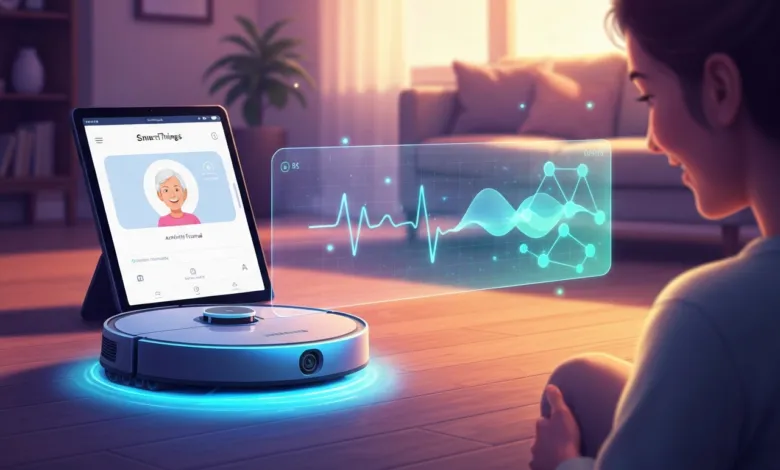
One feature, Care on Call, provides context before a phone call by displaying a monitored family member’s first and most recent activity of the day, step count, and local weather. This simple dashboard helps a caregiver understand if their relative is active and moving normally. For more direct monitoring, the Reassurance Patrol function uses a compatible Samsung robot vacuum as a mobile platform. If no movement is detected for a preset time, it can send an alert. Its integrated camera can identify a person lying on the floor, and its two-way audio allows for remote check-ins, effectively turning a cleaning device into an on-demand safety tool.
Care Insight focuses on environmental and behavioral patterns. It monitors temperature and humidity from connected appliances, sending alerts if conditions become unsafe. More subtly, it analyzes usage patterns of devices and tracks activity levels, flagging significant deviations from the previous week. A sudden decline in how often a refrigerator door is opened or a change in movement routines can serve as an early indicator of a developing issue.
Perhaps the most advanced capability is the cognitive decline detection system. By analyzing longitudinal data from mobile and wearable devices, it monitors metrics like speech patterns, typing speed, walking gait, and sleep to identify early warning signs. Alerts are then sent to designated caregivers. This approach taps into behavioral data that clinical research has linked to conditions like dementia, but which has historically been difficult to gather outside of formal studies.
These care features are enabled by an ambient sensing layer that uses millimetre-wave radar and sound sensors embedded in Samsung TVs and appliances. This system can distinguish between activities like sleeping, exercising, or working without relying on cameras in most instances. A key privacy safeguard is that all this sensor data is processed and stored locally on a SmartThings hub, not in the cloud. While alerts must be shared with family, the detailed activity patterns themselves are not transmitted to Samsung’s servers.
Samsung’s considerable advantage in this space is its massive scale and existing hardware footprint. With hundreds of millions of users and a deep appliance ecosystem, many homes already possess the necessary infrastructure. The company is also emphasizing interoperability, with SmartThings becoming the first major platform to fully support Matter-compatible cameras. The new hub integrates multiple wireless protocols and doubles as a wireless charger, supporting an open ecosystem where care monitoring could eventually extend beyond Samsung-branded devices.
Integration with Galaxy AI further automates the system. SmartThings can now learn routines automatically from phone sensor data, and a language model-powered assistant lets users create automations with voice commands. These routines feed directly into care monitoring, for instance triggering an alert if a loved one has not turned on a light at their usual time.
This shift toward remote care addresses a clear need for families separated by distance, but it introduces complex ethical questions. While the system requires opt-in consent from the person being monitored, consent dynamics within families can be nuanced, especially when cognitive decline is a concern. The cognitive screening feature raises specific issues regarding clinical validity. While it uses behavioral signals correlated with decline, the accuracy and false-positive rates of such a consumer-grade system are not publicly known. A false alarm could create undue stress, while a missed signal might offer dangerous false reassurance.
These challenges are not unique to Samsung. Other tech giants are integrating similar health features into their ecosystems. Samsung’s distinct position comes from its pervasive presence inside the home through appliances, providing more data touchpoints than a phone or speaker alone. Whether this results in genuinely better care or merely more extensive surveillance will depend on thoughtful feature design and transparent communication about the system’s capabilities and limitations to the families who use it. The elder care features are slated for release around the Galaxy S26 launch later in 2026.
(Source: The Next Web)