Acer Predator XB273U F5 Review: G-Sync Pulsar Blur Reduction
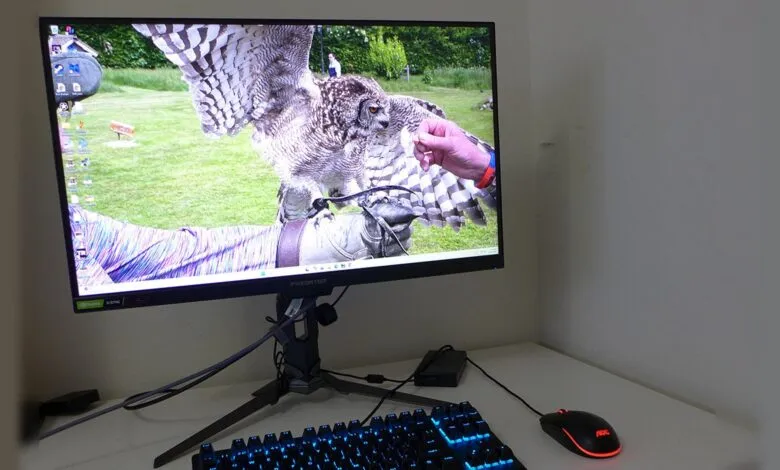
▼ Summary
– The Acer Predator XB273U F5 is a 27-inch QHD IPS gaming monitor featuring Nvidia’s new G-Sync Pulsar technology, which combines adaptive sync with blur reduction.
– G-Sync Pulsar provides exceptional motion clarity comparable to OLED, without reducing brightness or causing visual artifacts like tearing or flickering.
– The monitor has a 360Hz refresh rate, over 500 nits of peak brightness for HDR, and covers approximately 86% of the DCI-P3 color gamut.
– It includes a versatile stand with extensive adjustments, multiple video inputs (HDMI 2.1 and DisplayPort 1.4), USB ports, and internal speakers.
– The review concludes it is among the smoothest and quickest LCD gaming monitors available, representing a significant breakthrough in motion performance.
The Acer Predator XB273U F5 represents a significant leap forward for high-performance gaming displays, primarily through its implementation of Nvidia G-Sync Pulsar technology. This innovation effectively merges the tear-free smoothness of variable refresh rate (VRR) with the motion clarity of backlight strobing, a combination that has long been a goal for monitor engineers. The result is a 27-inch QHD IPS panel that delivers motion resolution rivaling premium OLED screens, all while maintaining full brightness and a blistering 360 Hz refresh rate.
Monitor technology continuously advances to eliminate visual imperfections during fast motion. Solutions like Adaptive-Sync tackle screen tearing, while overdrive settings and backlight strobing techniques such as ULMB aim to reduce perceived blur. G-Sync Pulsar is the next evolution, intelligently scanning the backlight in sync with the TFT layer to produce exceptionally clear motion without the typical trade-offs. The XB273U F5 is one of the first displays to harness this capability, built around a 2560×1440 IPS panel with an edge-array LED backlight necessary for the rolling-scan function.
Beyond its headline feature, the monitor boasts a robust specification sheet. It achieves a peak brightness exceeding 500 nits for both SDR and HDR content, backed by a contrast ratio measured around 1,100:1, which is above average for IPS technology. Color performance is strong out of the box, covering approximately 86% of the DCI-P3 gamut. The on-screen display (OSD) offers extensive customization, including gamma presets, RGB sliders, and a useful sRGB mode that, unlike many competitors, still allows for calibration adjustments.
Physically, the monitor carries the distinctive Predator aesthetic with a mostly bezel-free front. The stand, which some may liken to a robotic character, offers a wide range of ergonomic adjustments including height, tilt, swivel, and pivot into portrait orientation. A small central protrusion on the bezel houses ambient light sensors for the Ambient Adaptive feature, which automatically adjusts screen brightness and color temperature based on room lighting. Connectivity is comprehensive, featuring HDMI 2.1 and DisplayPort 1.4 inputs, a four-port USB 3.2 hub, and a 3.5mm audio jack alongside its modest internal speakers.
Enabling G-Sync Pulsar requires a compatible Nvidia GeForce RTX 40 or 50-series GPU connected via DisplayPort. Once activated, the difference in motion clarity is immediately apparent and transformative. In testing, moving patterns and fast-paced gameplay showed a level of sharpness that matched high-end OLED monitors, with no perceptible loss in brightness, flicker, or introduced artifacts like ghosting. The technology maintained this clarity effectively down to a configurable lower frame rate limit, around 90 fps, a threshold where conventional LCDs typically become blurry.
The overall gaming experience is exceptionally responsive, benefiting from very low input lag. The image quality is excellent for an IPS panel, with good contrast rendering detailed shadows and bright highlights. The HDR implementation provides flexibility, allowing users to select a peak brightness cap of either 400 or 500 nits to suit their environment and preference. For productivity, the 109 pixels-per-inch density provides sharp text and icons, making the monitor a capable dual-purpose tool.
A minor critique lies in the stand assembly, where a slight wobble can be detected at the fulcrum on some units, though this would be irrelevant if using a third-party VESA mount. Ultimately, the Acer Predator XB273U F5 stands as a landmark display. It delivers a combination of speed, smoothness, and motion clarity that sets a new standard for LCD gaming monitors, proving that exceptional performance can be achieved without sacrificing brightness or introducing visual compromises.
(Source: ZDNet)