NASA Team Races to Save Falling Satellite
▼ Summary
– NASA’s aging Swift Observatory has been offline for over a month and is falling out of orbit, awaiting a potential commercial rescue mission.
– Unlike flagship telescopes, Swift is considered a suitable candidate for a pioneering commercial rescue due to its lower cost and lower risk if a rescue fails.
– NASA awarded Katalyst Space Technologies a $30 million contract to build and launch a satellite to stabilize Swift’s orbit and extend its mission.
– Swift’s primary scientific role is to detect and rapidly locate gamma-ray bursts, the universe’s most powerful explosions, for other observatories to study.
– The spacecraft’s unique ability to quickly point at these fleeting events remains scientifically valuable, with no other US satellite fully replicating its capabilities.
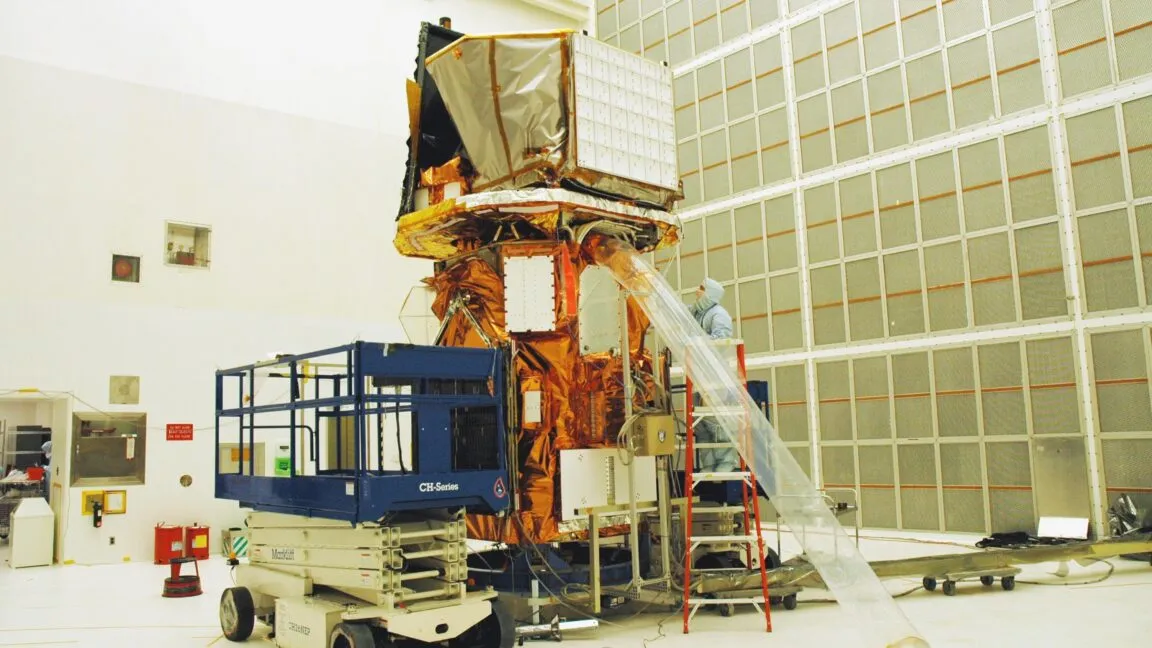
For more than a month, one of NASA’s longest-running astronomy missions has been silent. The Neil Gehrels Swift Observatory, a 21-year-old spacecraft, is slowly descending from its orbit, prompting a unique commercial effort to save it. Unlike flagship telescopes such as Hubble or Webb, Swift is not slated for a high-cost, crewed repair mission. Instead, NASA is pursuing a novel path, contracting a private company to attempt a robotic rescue that could set a precedent for future satellite servicing.
The observatory’s scientific value remains high despite its age. Launched in 2004, Swift was designed to detect gamma-ray bursts, the universe’s most cataclysmic explosions. These fleeting events occur without warning when massive stars collapse into black holes or when dense stellar remnants like neutron stars merge. Swift’s unique capability to rapidly swivel and pinpoint these bursts across multiple wavelengths before they fade has made it indispensable to astrophysicists. It serves as a critical alert system, guiding other observatories to these transient cosmic phenomena. No other U. S. satellite currently offers the same full suite of capabilities.
Swift operates in low-Earth orbit, where trace atmospheric drag gradually decays its trajectory. The mission has cost approximately $500 million in today’s dollars to develop, launch, and operate over two decades. While a substantial investment, this is far less than the cost of maintaining Hubble, which required multiple space shuttle servicing missions. The lower financial stakes make Swift an ideal candidate for a pioneering commercial rescue attempt, where the risks of failure are more acceptable.
Recognizing this opportunity, NASA awarded a $30 million contract last September to Katalyst Space Technologies. The company’s mandate is to swiftly design, build, and launch a small spacecraft that can dock with the observatory and boost it to a stable altitude. This approach represents a significant shift toward commercial satellite servicing, moving away from the traditional model of government-led, astronaut-assisted repairs. A previous proposal for a privately funded Hubble servicing mission was declined, underscoring how Swift’s profile makes it a more suitable first test case.
The success of this mission would not only extend the life of a vital scientific asset but also demonstrate the viability of a new market for in-orbit maintenance. As the spacecraft awaits its robotic savior, the scientific community continues to feel its absence, relying on a patchwork of other instruments that cannot fully replace Swift’s rapid response and multi-wavelength eyes on the sky.
(Source: Ars Technica)