CERN’s Upgraded Collider Discovers a New Particle
▼ Summary
– CERN announced the discovery of a new particle named “Xi-cc-plus,” the 80th particle identified by the Large Hadron Collider.
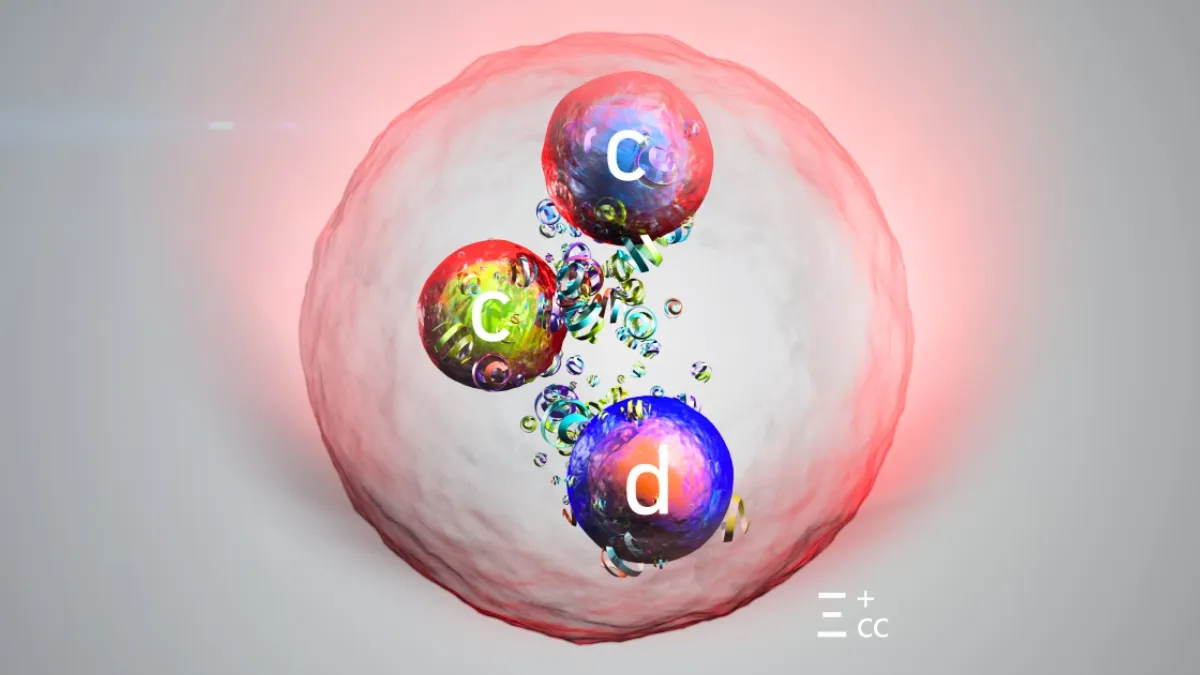
– The particle is a baryon composed of two heavy “charm” quarks and one “down” quark, making it four times heavier than a proton.
– This is only the second observation of a baryon with two heavy quarks and the first new particle found after 2023 detector upgrades.
– The discovery will help scientists test theories of quantum chromodynamics, which describes how quarks bind together.
– The find comes as CERN plans to build an even larger particle collider, the Future Circular Collider, to further explore the universe.
Scientists at CERN have announced a significant breakthrough with the discovery of a new particle, named Xi-cc-plus, using the upgraded Large Hadron Collider. This marks the 80th particle identified by the world’s premier particle accelerator and represents a major step forward in testing fundamental theories of physics. The particle’s unique composition offers a fresh window into the quantum forces that shape all matter in the cosmos.
This newly observed particle is a type of baryon, the same family that includes the protons and neutrons found in atomic nuclei. While common baryons are made from three light quarks, the Xi-cc-plus has a far more exotic recipe: it contains two charm quarks and one down quark. This configuration makes it exceptionally heavy, roughly four times the mass of a proton, due to the significant weight of the charm quarks. Its discovery validates long-standing predictions about possible combinations of quark “flavors,” which include up, down, charm, strange, top, and bottom.
Observing such a particle is a formidable challenge. Researchers at the LHCb experiment, one of the major detectors on the collider ring, achieved this by accelerating particles to near-light speeds and orchestrating high-energy collisions. From the resulting debris, they can trace the decay patterns back to infer the properties of extremely short-lived particles like the Xi-cc-plus. Vincenzo Vagnoni, spokesman for the LHCb experiment, noted this is only the second observation of a baryon containing two heavy quarks.
The find is particularly notable as it is the first new particle identified following major upgrades to the LHCb detector completed last year. It provides a crucial data point for physicists working on quantum chromodynamics (QCD), the theory describing the strong force that binds quarks together. Understanding how QCD operates in systems with multiple heavy quarks helps refine models of not just ordinary matter but also more exotic hypothetical particles like tetraquarks and pentaquarks.
This discovery follows the 2017 observation of a related particle with two charm quarks and an up quark. The new Xi-cc-plus has an even shorter lifetime, making its detection a more delicate feat. The Large Hadron Collider, the 27-kilometer underground ring straddling the French-Swiss border, continues to be an unparalleled tool for such investigations, most famously proving the existence of the Higgs boson over a decade ago.
The announcement arrives as CERN looks toward an ambitious future, with plans to construct an even larger machine, the Future Circular Collider. Each new discovery from the current collider helps chart the course for these next-generation experiments, pushing the boundaries of our understanding of the universe’s most basic constituents.
(Source: Science Alert)