Universal Robots & Scale AI Launch UR AI Trainer
▼ Summary
– Universal Robots launched the UR AI Trainer at GTC 2026, a system built with Scale AI to generate robot training data directly on production cobots, closing the lab-to-factory gap.
– The system uses a leader-follower setup where a human guides a robot, capturing synchronized motion, force, and visual data to train Vision-Language-Action models.
– Its key advantage is collecting force feedback data, allowing robots to learn contact-rich manipulation tasks that require responding to physical resistance.
– The platform integrates with Scale AI’s software to create a data flywheel, where demonstration data trains models that improve robot performance and inform further training.
– The launch was accompanied by a demo of Generalist AI’s embodied foundation models on UR robots, showing the goal of autonomous, reliable task execution without pre-programming.
A new hardware-software platform from Universal Robots, developed with Scale AI, enables manufacturers to create the precise datasets needed for advanced robotics directly on their own production floor equipment. This system, unveiled at NVIDIA’s GTC 2026 conference, directly tackles the persistent “lab-to-factory gap” by allowing AI models to be trained on the very same collaborative robots that will perform the tasks in live manufacturing environments.
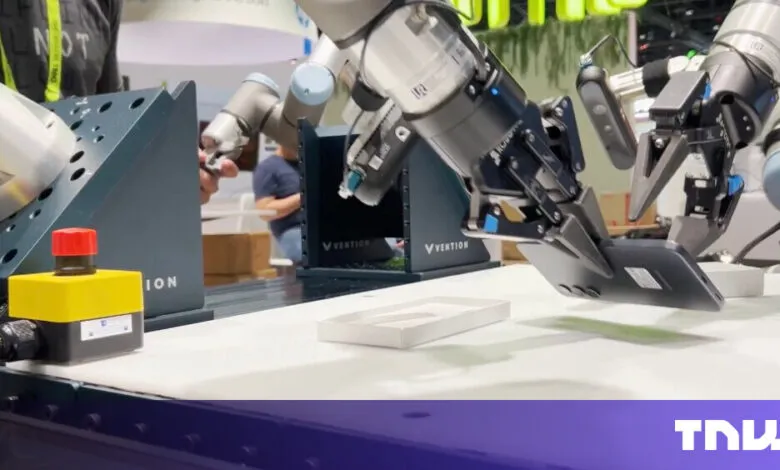
The UR AI Trainer operates on a leader-follower principle. An operator physically guides one robot, the leader, through a specific task. A second robot, the follower, mirrors every movement in real time. Throughout this process, the system captures a synchronized stream of motion paths, force feedback data, and visual imagery. This creates the rich, multimodal datasets essential for training sophisticated Vision-Language-Action models.
Critically, this data collection happens on standard UR industrial cobots. Training data gathered on a UR3e or UR7e in a dedicated cell can be used to train models that are then deployed on identical robots in active production lines. This eliminates the typical disconnect between research prototypes and industrial hardware.
Anders Beck, VP of AI Robotics Products at Universal Robots, emphasized the customer-driven need for this solution. He stated that clients are demanding a practical method to collect synchronized robot and vision data on their intended deployment platforms, positioning the AI Trainer as the industry’s first direct pathway from lab development to factory implementation.
The inclusion of force data represents a significant leap beyond vision-only training systems. While cameras can teach a robot where to go, they cannot convey the physical sensations of a task. UR’s system leverages its Direct Torque Control technology to record how an operation should feel. This is vital for contact-rich manipulation, tasks like assembly, insertion, or screwing that require a robot to sense and adapt to resistance. These are precisely the complex, delicate operations that have proven most difficult and costly to automate, often remaining reliant on human workers.
Scale AI’s role is to power the data lifecycle. Its software stack, integrated into UR’s AI Accelerator platform, structures and manages the information captured during demonstrations. The partnership is designed as a continuous improvement loop, or data flywheel: human demonstrations generate data, which trains models, which improve robot performance, which then informs better demonstrations and further training.
Ben Levin, General Manager of Physical AI at Scale AI, highlighted the synergy, noting that UR’s global industrial footprint provides an unparalleled foundation for capturing real-world data and deploying AI at scale. The companies plan to release a large-scale industrial dataset collected on UR robots later in 2026.
The demonstration at GTC illustrated the complete pipeline. Attendees could physically guide UR3e robots through a smartphone packaging task, with the data captured instantly by Scale’s software. A parallel virtual simulation, built in NVIDIA Omniverse, showed the same task being trained synthetically using haptic devices, illustrating a complementary simulation-to-real pathway.
The launch also featured the first public demo from startup Generalist AI, founded by former Google DeepMind and MIT researchers. Two UR7e robots, running Generalist’s embodied foundation model, autonomously executed the same packaging task. This showcased the end goal of the training pipeline: robots capable of reliably performing complex, contact-rich manipulations without pre-programmed, rigid instructions.
Pete Florence, co-founder and CEO of Generalist AI, described the demonstration as a translation of physical commonsense into real-world capability on a trusted industrial platform, paving the way for broad commercial deployment.
Universal Robots positions its vast installed base, over 100,000 cobots worldwide, as a unique advantage. The quality of an AI model hinges on the quality and volume of its training data, and UR’s global fleet represents a massive potential source of real-world manipulation data. The AI Trainer is the tool designed to unlock this resource.
The announcement is embedded within NVIDIA’s expanding physical AI ecosystem. The company is also exploring the use of its Physical AI Data Factory Blueprint to automate synthetic data generation, creating a comprehensive approach that blends physical demonstration data with simulated environments.
Amit Goel, Head of Robotics and Edge AI Ecosystem at NVIDIA, framed the shift as fundamental: moving from pre-programmed automation to generalist robots that learn through interaction. He stated that by leveraging NVIDIA’s simulation frameworks, Universal Robots is building the scalable infrastructure necessary to train the next generation of autonomous systems. This development arrives as physical AI attracts major investment, fueled by the success of large language models and the belief that similar data-centric scaling can revolutionize robot learning.
(Source: The Next Web)