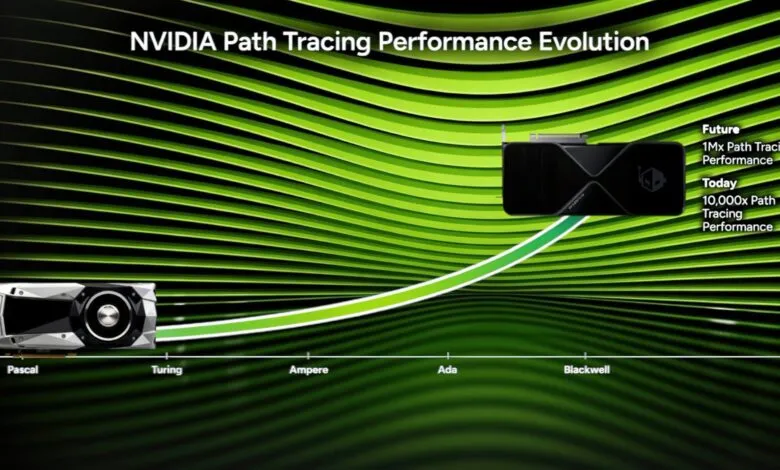
NVIDIA Claims 1,000,000x Leap in Path Tracing for Future GPUs
▼ Summary
– NVIDIA has previewed its upcoming graphics processing units (GPUs).
– These future GPUs are designed to deliver significant performance improvements in path tracing.
– The enhanced performance is attributed to advancements in artificial intelligence (AI).
– It is also credited to the company’s RTX technology.
– This information was reported by the source Moore’s Law is Dead.
The future of computer graphics is poised for a staggering transformation, with NVIDIA signaling a monumental leap in rendering capabilities for its next-generation GPUs. The company suggests that upcoming hardware, powered by continued advancements in artificial intelligence and its RTX technology stack, could deliver a performance increase in path tracing so vast it’s measured as a one-million-fold improvement over current methods. This isn’t a simple generational step; it represents a fundamental shift in how complex lighting and shadows are simulated in real-time.
Path tracing is a sophisticated rendering technique that meticulously models the way light interacts with objects in a scene, creating images of exceptional realism with accurate reflections, refractions, and global illumination. Historically, this process has been incredibly demanding on hardware, limiting its use primarily to offline rendering for films and high-end visual effects. The promise of real-time, cinematic-quality path tracing has been a long-standing goal in the graphics industry.
NVIDIA’s projected path hinges on the deep integration of specialized AI processors and enhanced ray tracing cores within its future GPU architectures. The vision involves using AI to denoise and reconstruct images far more efficiently, drastically reducing the number of physical light rays that need to be calculated by the hardware. This approach effectively bypasses many traditional computational bottlenecks. Instead of relying solely on brute-force increases in transistor count and clock speeds, a trend challenged by the slowing pace of Moore’s Law, NVIDIA is betting on a heterogeneous computing model where AI and RT cores work in concert to accelerate the entire pipeline.
Industry observers note that such a performance claim, while extraordinary, aligns with the company’s strategic focus on AI-accelerated computing. The potential applications extend far beyond gaming. Professional visualization, scientific simulation, and autonomous vehicle development are all fields that stand to benefit immensely from the ability to generate and interact with photorealistic environments in real time. This would enable architects to walk clients through perfectly lit digital buildings, scientists to visualize complex data sets with unprecedented clarity, and engineers to test systems in virtual worlds that mirror reality.
For gamers and creators, the implications are equally profound. The barrier between pre-rendered cinematic sequences and interactive gameplay could dissolve, enabling entirely new levels of visual fidelity and immersive storytelling. Environments could react to light sources with perfect physical accuracy, and dynamic time-of-day changes would occur without the visual artifacts or performance hits seen in today’s titles. It represents a move toward what some call the “holy grail” of real-time graphics.
While these projections outline a compelling roadmap, they refer to future technologies still in development. Realizing a million-fold improvement will require breakthroughs not only in silicon design but also in software algorithms and developer tools. The industry will be watching closely to see how these theoretical gains translate into tangible products and experiences. Nonetheless, the direction is clear: the fusion of AI and advanced rendering is set to redefine the boundaries of what’s possible in digital visualization.
(Source: wccftech)