Trump’s ‘Buy American’ EV Charger Rule Could Slow Expansion
▼ Summary
– The Trump administration proposed requiring EV chargers to be 100% US-made to receive federal NEVI program funding, a significant increase from the current 55% threshold.
– Industry and environmental groups argue this new “Buy America” requirement would effectively halt the national EV charging build-out because the current supply chain is heavily reliant on China.
– No existing US charging station meets the proposed 100% US-made standard, as critical components like power modules and advanced electronics are globally sourced.
– Critics view the proposal as a bad-faith tactic to stall the NEVI program and restrict clean transportation, aligning with the administration’s broader rollback of environmental policies.
– The timing disrupts states that were beginning to use NEVI funds for projects, such as Georgia’s plan to build dozens of new charging stalls with $134 million.
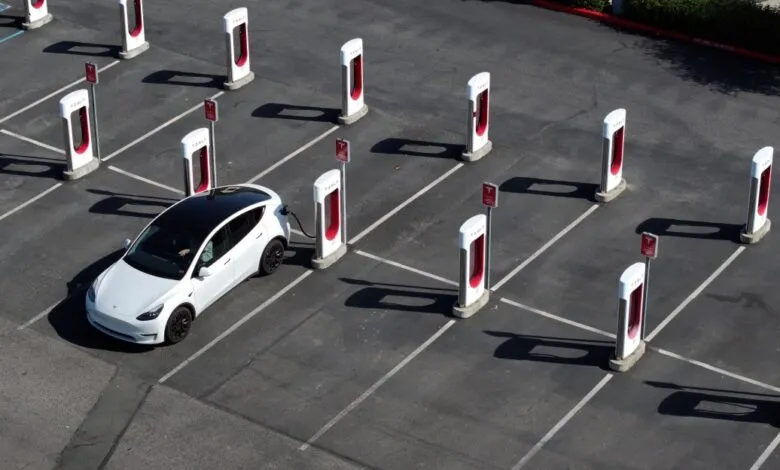
A new federal proposal mandating that all components for electric vehicle chargers be manufactured in the United States threatens to significantly delay the nationwide expansion of charging infrastructure. This rule, requiring 100% domestic content for projects to qualify for National Electric Vehicle Infrastructure (NEVI) program funds, is seen by many industry experts as an impractical standard that could halt progress at a critical moment.
The requirement represents a sharp increase from the current 55% domestic content threshold. Industry and environmental groups argue the policy will effectively stop EV charging build-out in its tracks, as the global supply chain for this equipment is deeply entrenched, with China playing a dominant role due to years of subsidized investment. While U.S. assembly of certain charger parts like enclosures and cables is growing, the sophisticated internal electronics and power modules are primarily sourced from overseas.
Albert Gore, executive director of the Zero Emissions Transportation Association, stated the proposal fails to align with current manufacturing realities. “This proposal does not meet industry where it is today and may discourage further investment in the production of U.S.-made EV chargers,” he said. “Ultimately, this will hinder the job growth that Buy America is intended to create.”
The move is widely interpreted as another attempt to stall the NEVI program, which was funded by the Bipartisan Infrastructure Law. After a previous effort to freeze the program’s $5 billion was overturned in court, this new domestic content rule acts as a de facto barrier. Critics see it as a bad-faith tactic that undermines congressional intent and public investment.
“This is yet another bad-faith attempt to kill NEVI and block the buildout of essential infrastructure Congress funded for all Americans,” said Katherine Garcia of the Sierra Club’s Transportation for All campaign. She warns it would stall deployment, set the U.S. further behind in the EV transition, and limit access to cleaner transportation.
Advocates for electric vehicles generally support gradually increasing domestic manufacturing requirements. However, they contend that an immediate leap to 100% is unworkable and reflects a misunderstanding of production capabilities. Ingrid Malmgren, policy director at Plug In America, called the rule “out of touch with U.S. manufacturing capacity,” noting that no currently operational U.S. charging station meets the proposed standard.
The timing creates acute disruption, as states were beginning to access long-promised NEVI funds to start construction. Georgia, for instance, planned to use $134 million to build dozens of new charging locations. The new rule throws those projects into uncertainty, creating a fresh bottleneck just as the program was gaining momentum.
Observers note that if the administration’s genuine goal was to bolster U.S. EV charger production, it would establish a realistic, phased timeline to attract investment and build domestic supply chains. Instead, the policy appears designed to restrict the promotion of cleaner transportation alternatives, continuing a pattern of regulatory actions that favor increased pollution over accelerated EV adoption.
(Source: The Verge)