Snapdragon X2 Elite Beats M5, 48% Faster Than X Elite
▼ Summary
– Qualcomm’s Snapdragon X2 Elite chipset outperforms Apple’s M5 in three out of five benchmarks, despite consuming only 5W more power.
– The benchmark results are from a pre-production ASUS Zenbook sample, meaning final retail performance may differ.
– The Snapdragon X2 Elite shows significant performance gains over its predecessor, the Snapdragon X Elite, in these tests.
– No battery life tests were conducted due to the early nature of the hardware and software used for benchmarking.
– The article includes specific benchmark results, such as a 24.2% multi-core performance lead over the M5 in Cinebench 2024.
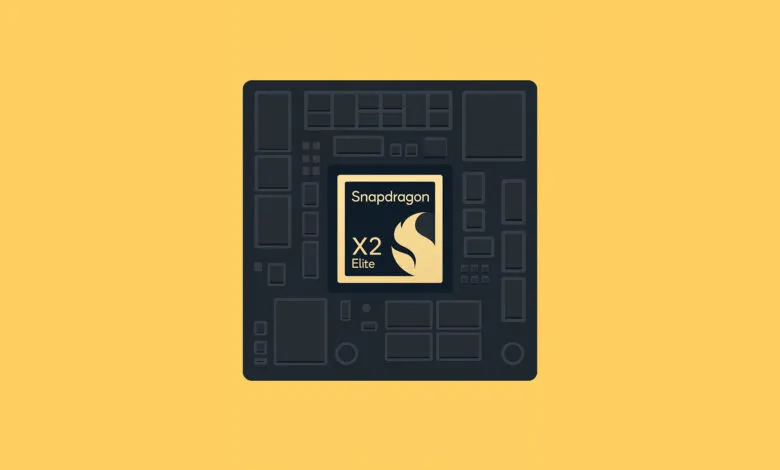
Qualcomm’s latest Snapdragon X2 Elite processor demonstrates significant performance gains in early testing, outpacing its predecessor and competing directly with Apple’s M5 chip in key benchmarks. This new silicon represents a bold step forward for Windows laptops, promising enhanced power efficiency and raw computing capability. Early results from a pre-production ASUS Zenbook unit, while preliminary, paint an encouraging picture for the chip’s potential when it launches later this year.
The benchmark data, shared by Hardware Canucks, reveals the Snapdragon X2 Elite beating the M5 in three out of five tests while operating at a 31W power envelope. This is a mere five watts higher than the M5’s 26W ceiling, suggesting impressive performance-per-watt characteristics. It is crucial to remember these figures come from early drivers and firmware, so final retail performance may vary. The tests did not include battery life evaluations, leaving that critical metric for future reviews of commercial devices.
In the Cinebench 2024 multi-core test, the Snapdragon X2 Elite scored 1,432 points, making it 24.2 percent faster than the M5. Perhaps more strikingly, it showed a 48.7 percent performance leap over the previous Snapdragon X Elite. This generational improvement is substantial. The single-core story was different, with the M5 retaining a strong lead of 37 percent in that specific test.
Real-world application benchmarks yielded mixed but promising results. In Blender 5.01, the X2 Elite completed the task in 3 minutes and 31 seconds, significantly faster than both the X Elite (5:24) and the M5 (5:33). For video encoding using Handbrake, the new Qualcomm chip finished in 3:29, beating the X Elite’s 5:32 but trailing the M5’s time of 5:14. The most notable deficit appeared in a DaVinci Resolve test, where the M5’s time of 9:43 vastly outperformed the X2 Elite’s 22:06, highlighting areas where optimization may still be needed.
These early glimpses suggest Qualcomm is making serious inroads. The performance uplift from the X Elite to the X2 Elite is particularly compelling for multi-threaded workloads. However, the competitive landscape remains fierce. Intel’s Core Ultra X9 388H has also mounted a formidable comeback in the x86 space, as seen in other reviews, ensuring that the battle for laptop CPU supremacy is far from decided. Consumers should await final, retail-ready hardware and comprehensive battery tests before drawing definitive conclusions about this new generation of ARM-based Windows processors.
(Source: WCCFTHECH)