Black Hole ‘Burps’ Death Star-Like Energy
▼ Summary
– In 2022, astronomers were surprised when a faded 2018 tidal disruption event (AT2018hyz) reanimated and emitted bright radio waves.
– Since then, the event has grown 50 times brighter and continues to increase, with its energy emission potentially not peaking until 2027.
– A common misconception is that black holes act like vacuum cleaners, but they only permanently consume matter that crosses the event horizon.
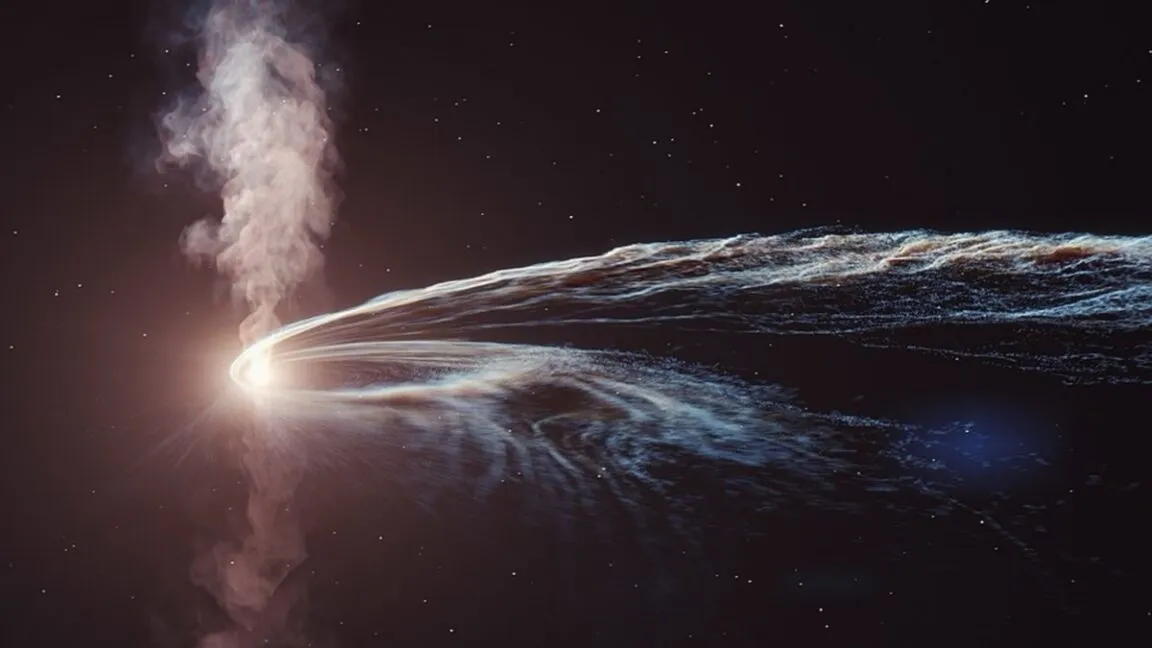
– During a tidal disruption event, a star is shredded by a black hole’s gravity, with part of its mass ejected outward and potentially forming a bright accretion disk.
– These violent ejections can create jets, which allow astronomers to detect black holes indirectly, though such outflows usually happen soon after the initial event.
Astronomers are witnessing a truly extraordinary cosmic event as a dormant black hole has dramatically reawakened, unleashing a powerful jet of energy that continues to grow brighter years after it first consumed a star. This phenomenon, known as a tidal disruption event (TDE), challenges common misconceptions and offers a rare glimpse into the chaotic feeding habits of these mysterious objects. The event, cataloged as AT2018hyz, has not faded as expected but has instead become over 50 times brighter and may not reach its peak intensity until 2027, according to new research.
The story began back in 2022 when scientists, including University of Oregon astrophysicist Yvette Cendes, revisited data on an event that had initially seemed to fade away. To their surprise, the black hole, playfully nicknamed “Jetty McJetface”, had reactivated, emitting an intense burst of radio waves. Continuous monitoring has revealed that this was no brief afterglow. The energy output has been climbing steadily, defying typical models for such stellar disruptions.
A common but inaccurate belief is that black holes act like perfect cosmic vacuums, irrevocably swallowing everything nearby. The reality is far more complex and messy. Only material that crosses the invisible boundary called the event horizon is trapped forever. When a star ventures too close, the black hole’s immense gravity stretches and shreds it, a process often called “spaghettification.” Not all of that stellar material falls in. A significant portion is violently ejected outward at tremendous speeds.
This ejection can form a swirling, superheated ring of debris known as an accretion disk around the black hole, which glows intensely with X-rays and visible light. Sometimes, the interaction also channels material into narrow, focused beams or jets that shoot out from the poles. These jets are a key method astronomers use to detect and study black holes indirectly. Usually, such outflows happen almost immediately after the star is torn apart.
The case of AT2018hyz is peculiar because its powerful jet appeared with a surprising delay of several years. This lag suggests our understanding of how accretion disks form and power these jets is incomplete. The ongoing brightening indicates the black hole is still actively feeding on the remains of its stellar meal, providing an unprecedented opportunity to study the physics of these extreme environments over an extended period. Each new observation helps peel back the layers on how black holes influence their surroundings and redistribute energy across the cosmos.
(Source: Ars Technica)