Humanoid Robot Can Now Deliver Your Toothbrush
▼ Summary
– Sprout is a new, relatively inexpensive humanoid robot designed for customer service in hotels, shops, and restaurants, not for industrial tasks.
– It is priced from $50,000 and is being marketed for roles like a hotel butler, with initial customers including Disney and Boston Dynamics.
– The robot is designed to be easy to program and comes with software for autonomous navigation, language model access, and teleoperation, making it useful for research.
– Unlike most humanoids, Sprout is built for human interaction, featuring expressive mechanical eyebrows and capabilities for understanding and navigating human environments.
– Its launch is part of a booming U.S. humanoid robot industry, with many companies developing such systems despite uncertainty about their ultimate practicality.
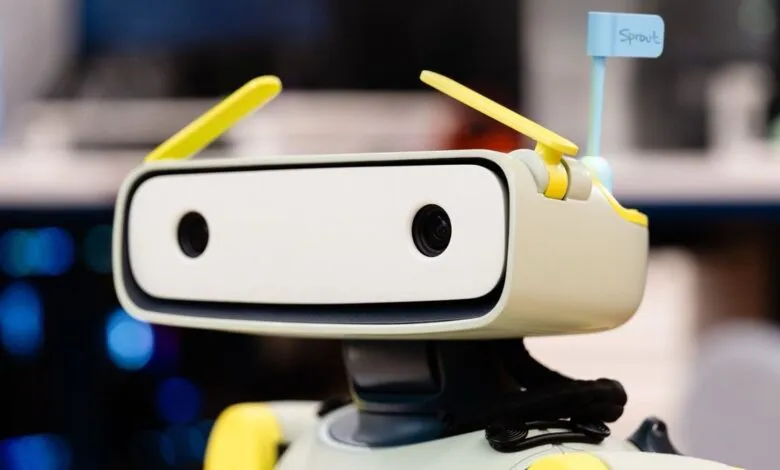
A new wave of humanoid robots is moving beyond factory floors and into customer-facing roles. The latest entry, a robot named Sprout, is specifically designed for service in hotels, shops, and restaurants. Developed by the startup Fauna, Sprout is a lightweight and engaging machine, roughly the size of a child, built to be safe and approachable for public interaction. Its creators focused on making a system that is not only capable but also affordable and easy to integrate into existing businesses.
Fauna’s cofounder and CEO, Robert Cochran, explains the vision was to build something fundamentally different. The goal was a robot that feels engaging and safe to be around, yet is still sophisticated enough to perform useful tasks. Sprout is now available for purchase starting at $50,000, and the company is already in discussions with hotels interested in using it as a robotic butler to deliver items like toothbrushes directly to guests.
This launch occurs as the humanoid robotics sector in the United States experiences significant growth. Numerous companies are investing in the technology, though its ultimate practicality remains unproven. Key players include established names like Boston Dynamics, which is integrating Google’s AI, and Tesla with its Optimus project, alongside startups such as Agility Robotics and Figure AI. The field is competitive, with Chinese firm Unitree also selling lower-cost humanoids for research and entertainment, though fully equipped models reach a similar price point to Sprout.
Fauna’s initial client list is impressive, including Disney, a company with existing robotics experience in its parks, and Boston Dynamics itself. Cochran emphasizes that Sprout is designed for simplicity in programming, making it attractive for research institutions. It comes equipped with software for environmental scanning, autonomous navigation, and access to language models. It can also be teleoperated immediately, which aids in training. Researchers at New York University are already using Sprout to study robotic manipulation and how humans interact with machines. The company has also developed specialized technology to help the robot recover its balance if it trips.
While many humanoids are marketed for industrial automation, Fauna sees a nearer-term opportunity in service and entertainment. Cochran demonstrated interfaces for Sprout, including an app that shows the robot’s point of view and a real-time coding platform. A distinctive feature is its focus on human interaction; Sprout is equipped with mechanical eyebrows to convey expressions like interest or surprise, a design choice meant to foster a more natural connection.
The team’s background includes experience at major tech firms like Meta and Google. Cochran points out that advances in AI, particularly in object recognition systems developed for devices like smart glasses, will be crucial for robots needing to operate in human spaces.
During a demonstration, the robot’s potential was on display. Cochran asked Sprout to check the contents of a refrigerator. Using a large language model to interpret the command, the robot ambled over to an office fridge, peered inside, and returned to report the presence of several sodas. This simple act of understanding a verbal request, navigating a space, and reporting back represents a significant step. Cochran describes it as a foundational “Hello World” moment for accessible robotics, suggesting that such straightforward, useful interactions are the key to broader adoption. From this basic capability, he believes, far more complex applications can be built.
(Source: Wired)