Unveiling the Mystery of Electrides
▼ Summary
– Earth has significantly less of certain light elements like hydrogen and carbon compared to the Sun, a mystery scientists have studied for nearly a century.
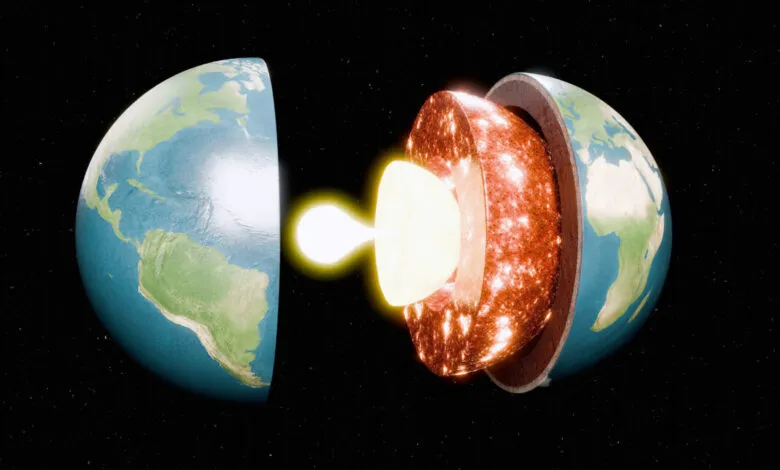
– A new theory suggests these missing elements may be absorbed into Earth’s solid inner core, where extreme pressure creates a unique form of iron called an electride.
– This electride iron in the core could gradually capture light elements over billions of years, explaining the inner core’s lower-than-expected density.
– Electrides are gaining scientific attention as they can now be synthesized at room temperature and are highly reactive, making them excellent catalysts.
– One electride catalyst is already used to produce ammonia more efficiently, and research into new electrides promises greener methods for making pharmaceuticals.
For nearly a century, a fundamental question has puzzled geoscientists: what happened to Earth’s missing light elements? Our planet shows a significant deficit of hydrogen, carbon, nitrogen, sulfur, and noble gases like helium when compared to solar and meteoritic abundances, with some elements depleted by over ninety-nine percent. While some loss during planetary formation accounts for part of the gap, scientists have long believed another mechanism was at work.
A recent study proposes a compelling answer, suggesting these elusive elements are sequestered within Earth’s solid inner core. Under the immense pressures found there, approximately 360 gigapascals, or 3.6 million times atmospheric pressure, iron undergoes a remarkable transformation. It becomes an electride, an exotic state of matter where electrons act as anions. This unique form of iron has a powerful capacity to absorb and trap lighter elements.
According to Duck Young Kim, a solid-state physicist and study coauthor, this absorption process could have occurred gradually over billions of years and might even continue today. This theory elegantly explains seismic data indicating the inner core’s density is five to eight percent lower than predicted for pure iron-nickel alloy.
Electrides are emerging as materials of significant scientific and industrial interest. Beyond potentially solving a planetary mystery, researchers can now synthesize various electrides under ambient room-temperature conditions. Their defining characteristic is the presence of loosely bound, highly reactive electrons that are readily donated. This property makes them exceptional catalysts, capable of driving difficult chemical reactions with greater efficiency.
One practical application is already in use: a specific electride catalyzes ammonia production, a vital process for manufacturing fertilizer. Its developers report this method reduces energy consumption by around twenty percent compared to conventional techniques. Chemists are actively exploring new electrides, which could pave the way for more economical and environmentally friendly routes to produce pharmaceuticals and other important chemicals.
(Source: Ars Technica)