Claude AI Apps Launch for Slack and Workplace Tools
▼ Summary
– Anthropic has launched a new feature allowing Claude Pro, Max, Team, and Enterprise users to access interactive third-party apps like Slack, Canva, and Figma directly within the chatbot.
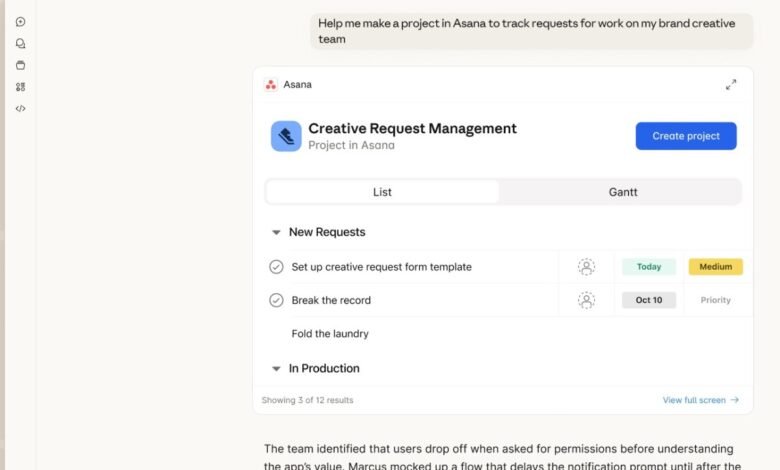
– These integrated apps enable Claude to perform tasks such as sending Slack messages, generating charts, and accessing cloud files when the user is logged into the services.
– The system is built on the Model Context Protocol, an open standard, and is similar to OpenAI’s Apps system launched in October.
– The apps will be particularly powerful when integrated with Claude Cowork, a new agent tool for handling multi-stage tasks, though this integration is not available at launch.
– Anthropic advises caution when using these agentic systems, recommending users monitor activity closely and avoid granting unnecessary access to sensitive information.
Anthropic has introduced a new capability for its Claude AI, allowing users to access and operate interactive applications directly within the chatbot’s interface. This significant update, announced this week, brings a suite of workplace tools into Claude’s environment, enabling a more seamless and integrated workflow for professional users. The initial lineup focuses on productivity and collaboration, featuring integrations with Slack, Canva, Figma, Box, and Clay, with a Salesforce connection anticipated in the near future. Once activated, these apps create a logged-in instance that Claude can access, permitting actions like sending team messages, generating visual content, or retrieving documents from cloud storage.
The company emphasized that combining Claude’s analytical intelligence with dedicated visual interfaces for specific tasks, like data analysis or content design, can dramatically accelerate work and iteration cycles. This functionality is not available to free users; it is reserved for those on Pro, Max, Team, and Enterprise subscription plans. Eligible subscribers can browse and enable these tools through a dedicated directory on the Claude website.
This development mirrors a similar system launched by OpenAI last fall, where interactive third-party tools can be summoned within a chat. Both integration frameworks are constructed on the same foundational technology: the Model Context Protocol (MCP). This open standard, originally introduced by Anthropic earlier in the year, received official support for applications in November, incorporating collaborative work from multiple organizations in the AI space.
The potential of these new apps expands considerably when paired with Claude’s recently launched agent tool, Claude Cowork. This feature, built upon the Claude Code architecture, allows users to delegate complex, multi-step projects that involve large datasets, tasks that traditionally required command-line expertise. When integrated with the new apps, Cowork could be instructed to perform actions like updating a design file in Figma using the latest assets or analyzing new sales data pulled from a company’s Box storage. Although the apps are not yet live within the Cowork agent at this initial launch, Anthropic has confirmed this integration is a priority for imminent development.
With the increased power of such agentic systems comes a need for careful management. Anthropic’s own safety guidelines for Cowork explicitly advise users to maintain close oversight and to limit permissions strictly to what is necessary for the task. The company recommends exercising particular caution regarding sensitive materials, such as financial records or personal credentials, and suggests establishing a dedicated, isolated working folder for Claude’s operations rather than providing broad access to entire systems.
(Source: TechCrunch)